Manaslu Circuit Packing List: Honest Day-By-Day Tips on What to Wear and Pack
If there’s one thing you don’t want to get wrong, it’s your Manaslu Circuit packing list.
It doesn’t matter too much if you forget your gloves for a half-day hike in your hometown, but on an 11-day high-altitude trek in Nepal? It’s a different story. Knowing what to pack for the Manaslu Circuit Trek will set you up for success.
This year, I completed the Manaslu Circuit Trek in 13 days.

After almost two weeks of big smiles and sore muscles, I’m sharing my complete Manaslu packing list, along with a day-by-day breakdown of what to wear on the Manaslu Circuit. I hope these first-hand tips help you feel prepared for what is genuinely a once-in-a-lifetime trek.
If you’re still planning your route, itinerary or budget, you can read my full Manaslu Circuit Trek guide here. It covers everything you need to know before you go.
Disclosure: This post includes affiliate links. If you decide to click through and make a qualifying purchase, I will receive a small commission at no extra cost to you – thanks for your support.
I received a discounted rate on this trek in exchange for sharing my experience. As always, all opinions are my own, and I only recommend experiences I genuinely enjoyed.
Why Is Your Manaslu Trek Packing List So Important?
The Manaslu Circuit stretches from 869 metres to 5,106 metres. Therefore, it goes from hot and humid to very cold in less than 13 days.
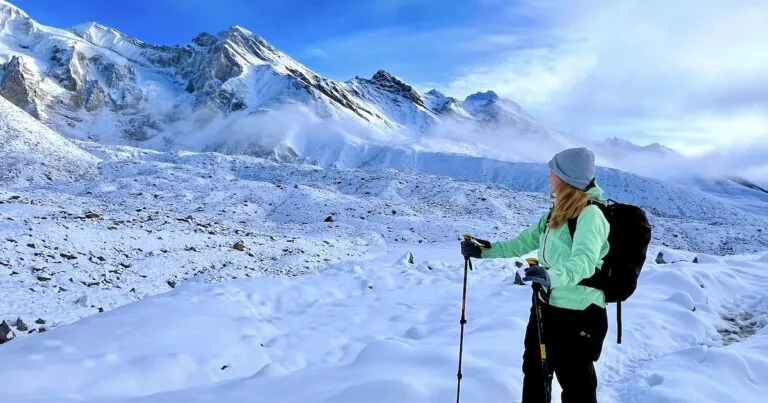
You’ll spend around three days of hiking in the heat and direct sun, then face temperatures as low as -5°C at the Larke Pass (Larkya La Pass)… and, if you’re lucky like me, you may even trek in fresh snow. I had 5 – 7 inches at the top.

Snow on the Larke Pass!

Hot and humid first few days.
can you buy clothes and gear on the Manaslu Circuit Trek?
Short answer: no. The Manaslu Circuit is an up-and-coming Nepal trek. It’s not as well-established as the Everest Base Camp trek, where you can buy some gear along the route.
You need to bring everything with you.

You can pick up basic snacks (chocolate bars, nuts, crisps, etc), toilet paper and some other essentials at most teahouses. There’s also one place selling limited clothing on day three, between Jagat and Deng, but that’s it.
Weather and Temperature on the Manaslu Circuit
To understand what to pack for the Manaslu Circuit, you also need to know what to expect from the weather and temperature.
What’s the temperature on the Manaslu Circuit Trek?
The temperature on the Manaslu Circuit typically ranges from -10°C to 27°C (14°F to 81°F) depending on the season.
Here’s a breakdown of the temperatures you can expect:
- Days 1 – 2 (20°C – 27°C / 68°F – 81°F ): Hot, humid weather and often in direct sun.
- Days 3 – 6 (5°C to 16°C): Gradual drop in temperature. Layering is key.
- Days 7 – 10 (-10°C to 10°C): Cold, often below freezing at higher altitudes.
- Day 11 (10°C to 23°C): Warms up quickly as you descend.
- Van to and from Manaslu: The temperature is hot and humid, but air-conditioning can be chilly.
Preparing for all weather conditions: sun, rain and snow

The first thing to be aware of is the sun. At high altitudes, the UV is high, so you need adequate sun protection:
- SPF 50+ sun cream
- Sunglasses with UV protection (snow blindness is a real risk)
- Sun hat
Weather can also change quickly, especially in shoulder seasons:
- Waterproof jacket and trousers (15,000–20,000mm rating)
- Waterproof footwear (Gore-Tex recommended)
Trust me – you don’t want wet feet! And on the Larke Pass, it’s potentially dangerous.

Can you hike without a guide?
You can’t do the Manaslu Circuit without a guide. I trekked with and genuinely recommend Himalayan Masters.
They’ve done a lot of work to forge the connections that make the Manaslu Circuit possible today, and know the area inside and out – using local guides.
They offered a code for my readers, KATIE5, for 5% off your trek.
Complete Manaslu Circuit Packing List
Before I share what to wear on the Manaslu Circuit day-by-day, here’s my full Manaslu trek packing list.
There are a few important things to remember:
- Layers are key. The weather and temperature can change quickly. You’ll also warm up while trekking and cool down quickly during breaks.
- Merino wool clothing is optimal. It doesn’t get stinky quickly and responds to your body temperature, helping to regulate your temperature.
- Don’t forget a neck gaiter, ear coverings, gloves and sunglasses.
- Invest in the right waterproofs (at least 15,000-20,000 mm minimum).
1. Hiking bags
If you’re hiring a porter:
- Day pack: 25 – 30 litres
- Waterproof bag cover
- Money belt to carry valuables in the village/teahouses
If you’re using a porter, the total weight of your bag should still be under 20kg. Some porters carry two bags, so less is better. My bag weighed around 15kg.
If you’re carrying your own gear:
- Backpack: 50 – 65 litres
- Day pack (for side trips): 25 – 30 litres
- Waterproof bag covers
- Money belt
If you’re not hiring a porter, it’s important to pack light. Your bag should ideally weigh under 15kg.

Should you hire a porter for the Manaslu Circuit?
A porter is optional for the Manaslu Circuit, but it can make the trek much more enjoyable. Carrying your own gear is difficult, with the long days and altitude.
With Himalayan Masters, my porter cost $260 USD for the full trek ($20 per day). I was glad about my decision after seeing other hikers in my group regretting their decision not to.
Most trekking companies, including Himalayan Masters, provide the large waterproof duffle bag to be carried by your porter.
2. Valuables
- Passport and photocopy.
- Travel insurance details (must cover helicopter rescue and trekking over 5,000 metres).
- Trekking permit (usually kept by your guide).
- Cash (rupees): Aim to bring 1,000 – 2,000 NPR per day.
- Cash (USD): Bring tips for your porter and guide (at least 10% of the total price is recommended).
- Waterproof ziplock plastic bag to keep valuables dry. Plastic is fine.
- Physical map and itinerary
3. Tech
- Mobile phone and case
- Local SIM card (NTC has the best signal – I grabbed mine from this NTC shop in Thamel)
- Battery pack (essential for Dharmasala and the Larkya La Pass)
- International travel adaptor (covering type C and D)
- Camera (if needed) and case
- Charging cables
- Headphones/earphones
- E-book reader (books are a little heavy!)
4. Shoes
- Hiking boots with ankle support (Gore-Tex)
- Trainers/sneakers (lightweight Gore-Tex)
- Sandals or flip flops to wear around the teahouse
- Crampons (for ice) – these were provided to me by Himalayan Masters and essential
Tips:
- Break in your hiking boots before your trek and bring a backup pair of trainers/sneakers (also with Gore-Tex). I had a problem with my hiking boots and ended up wearing my Gore-Tex trainers for 9 of the 11 days. I don’t recommend it.
- Proper ankle support is important. A lady in my trekking group had a bad ankle sprain after slipping in boots without ankle support.
5. Clothes
- Down jacket (mine was provided)
- Lightweight waterproof jacket
- Thermal hat
- Neck gaiter or scarf
- Ear headband – I used my neck gaiter for this, but a specific ear covering would be better
- Warm fleece
- Lightweight fleece or jumper
- Long-sleeve hiking top
- 2 hiking t-shirts (ideally merino wool)
- 2 sports bras (ideally merino wool)
- 2 thermal base layers (ideally merino wool)
- 2 lightweight hiking shorts
- Lightweight hiking trousers
- Waterproof over-trousers
- Cotton trousers or tracksuit – for the teahouses
- Lightweight underwear
- 3 – 5 pairs of merino wool socks – thicker is better to prevent blisters
- Lightweight gloves
- Heavy-duty waterproof winter gloves
Tips:
- Merino wool is, hands down, the best material. It helps to regulate your body temperature and doesn’t get smelly fast.
- Some blogs suggest packing 2-3 pairs of underwear. I ignored this advice and packed at least one pair of underwear for every day, and I did not regret it. I used lightweight briefs that weighed virtually nothing.
- I packed more socks than everyone else, and again, didn’t regret it. I re-used my 4 pairs of merino wool hiking socks and reserved 2 clean pairs for the teahouses.
6. Sleeping gear
- Sleeping bag (suitable for -10°C) – usually provided by your guide
- Ear plugs
- Eye mask
Most teahouses provide a pillow and (on request) a blanket. From Shyala (3,500 metres), most trekkers sleep in their sleeping bags for added warmth.
I’m from Wales, and used to cold weather at night (I’ll warm up by doing some squats, then jump under the blanket) – I only used my sleeping bag at the highest sleeping elevation in Dharmasala, but speaking to other trekkers, I was the exception.

7. Toiletries
- Toothbrush and toothpaste
- Face wash
- Moisturiser
- Sun cream
- Mosquito repellent for lower altitudes
- Soap (lighter than shower gel).
- Wet wipes – on some days, you can’t shower because it’s too cold.
- Razors
- Nail clippers
- Hair bands/ties
- Microfibre towel (quick-drying and light)
I recommend using travel-sized containers for your toiletries. It really helps to keep your bag light.
8. Medication and First-Aid
Guides will carry a first-aid kit. However, it helps to carry your own basic first-aid, especially for small issues like blisters.
- Hand sanitiser
- Personal prescription medication
- Blister plasters: The thicker, the better. The more, the better.
- First-aid supplies, including large plasters and bandages
- Duct tape – honestly, this works better than blister plasters!
- Plasters (varying sizes)
- Antiseptic wipes
- Motion sickness pills for the journey to the trailhead
- Imodium
- Anti-allergy pills
- Anti-acids
- Painkillers (such as paracetamol and ibuprofen)
- Eye drops
- Decongestants (runny/blocked noses are common at high altitude)
- Rehydration sachets (ORS)
- Electrolyte sachets (for hot trekking days)
9. Other essentials
- Water purification tablets (often provided by the trekking company)
- 2 water bottles with a total capacity of two litres
- Hiking poles
- Toilet roll – you can buy toilet roll on the trek, but it’s best to bring one with you to start.
- Playing cards or dice
Your water bottles need to hold at least two litres. There aren’t always safe places to fill your water bottle, so most trekkers are advised to pack and purify two litres for the morning trek.
At lunch, you can fill and purify another two litres ready for the afternoon. You’re recommended to drink at least 4 – 5 litres of water per day.
10. Food and Snacks
- Specialist food supplies for dietary restrictions
- Snacks for the trail – ideally high in calories and carbohydrates for energy. E.g. granola/energy bars, trail mix, protein bars, dates or raisins or chocolate.
What Food Should You Bring to The Manaslu Circuit?
My trekking package included three meals and three drinks per day. I could order additional dishes from the teahouses using my own money (payment is in local currency).
However, you should bring your own snacks for the trail, as there’s not always time to stop at a teahouse every two hours. Basic snacks are sold along the trail, including chocolates, crisps and nuts, but the selection is limited.
Food on the Manaslu Circuit is varied and served in large portions. However, if you have special dietary restrictions (for example, gluten restrictions), you should always bring your own supplies.
I’m gluten intolerant (not an allergy), and found it much easier than expected. Every teahouse prepared me white rice and scrambled eggs for breakfast, except for Dharmasala, which offered me rice pudding.
If you have an allergy, you may feel it’s safer to bring your own specialist food to avoid cross-contamination.
What to Wear on the Manaslu Circuit
That brings me to what to wear on the Manaslu Circuit, where I think it’ll be helpful to provide my day-by-day account with lessons I learned along the way.
It bears repeating: layers are key. They add thermal insulation by trapping layers of air. They’re also easy to remove/add while trekking.
Days 1 – 4 (Machha Khola to Namrung): Hot, humid conditions
On the drive to Maccha Khola, on day one, it’s hot and humid. It’s likely you’ll have air-conditioning on the first van or bus, but not on the four-wheel drive to Machha Khola. Therefore, I recommend wearing your hiking shorts, sports bra (if needed) and merino wool t-shirt.
Now, here’s my biggest piece of advice. Wear that same outfit when you’re trekking for the next 3 days.
Every day, when you reach the teahouse on days 1 – 4, change into your clean hiking clothes (the clean hiking shorts and t-shirt) and sleep in them.
Why do I recommend this? For the first two days, the conditions are very hot and humid, with temperatures of up to 27°C (81°F). You’ll hike from 869 metres to 1340 metres, with 20-kilometre hiking days, and get hot and sweaty.

It may feel gross to wear the same outfit for four days, but it’s necessary if you want to feel comfortable later in the trek.
You can try washing clothes on days 1 – 3 because it’s hot, but they don’t always dry completely, and then they stink. I tried this with some underwear, and it was a disaster.
Ideally, your hiking t-shirts will be made from merino wool. My merino wool t-shirt didn’t get stinky until day four.

When you reach Namrung, at 2,630 metres, on day four, you’ll feel a small chill. You’ll need a lightweight fleece and hiking trousers to wear that evening.
Days 5 – 7 (Namrung to Samagaon): Time to Change – It gradually gets colder
Once you’re in Namrung, on day five, I recommend changing your outfit. Put on your clean hiking t-shirt, hiking trousers and a lightweight longsleeve top.
You’ll be climbing to Shyala at 3,500 metres, where it’s significantly colder, so you will need the layers. In the evening, I had to wear my cotton tracksuit bottoms, t-shirt, light fleece, two pairs of socks and a warm down jacket to keep warm.


The next two days are spent between Shyala Village (3,500 metres) and Samagaon (3,530 metres), which are at similar altitudes and require similar clothing.
When you’re hiking at these altitudes, you’ll need layers. I always wore my lightweight hiking trousers (with waterproof over-trousers when raining) and an assortment of top layers (usually my hiking t-shirt, long-sleeve hiking top and a light fleece).
As soon as I climbing a hill, I found myself stripping off those outer layers.

In the evenings, at the teahouses, the temperature drops significantly. I wore a couple of warm layers, as well as my down jacket. In bed, I slept in my thermals under the blanket, although some people already started to use their sleeping bag.
Days 8 – 11 (Samdo to Bhimtang via the Larke Pass): Cold weather gear Is Necessary
On day eight, I felt the biggest shift in temperature. We hiked from Samagaon to Samdo (3,530 to 3,875 metres).
In Samagaon, I had been wearing my down jacket to keep warm in the mornings and evenings. However, I usually only had a couple of layers underneath.
In Samdo, however, it was cold. Unless I was hiking, I always wore a thermal base layer with at least 2 – 3 warm layers, a down jacket, neck gaiter and multiple pairs of socks.
When I was hiking, I also needed a bit more: hiking trousers with the pull-over waterproof trousers, a thermal base top, a fleece and my lightweight waterproof jacket.

On day 10, when I reached Dharmasala (4,450 metres), it was below freezing. Around 5 – 6 inches of snow packed onto the ground throughout the afternoon, evening and night.
This was the coldest day and night – dropping below -5 °C – and everyone struggled to keep warm before the teahouse lit the woodburner. I was wearing every single layer I owned, and still couldn’t keep warm, so most of us crept into our sleeping bags to warm up.
What to Wear for the Larke Pass and Dharmasala
In Dharmasala, I wore practically my entire kit: four pairs of merino wool socks (yes, I’m so serious) in my hiking boots, two layers of full-body thermals, a t-shirt, a long-sleeve hiking top, two fleeces, a down jacket and trousers with waterproof over-trousers. I also had on my neck gaiter, gloves and a warm hat.
When you go to sleep, it’s best to wearing your hiking outfit for the next day. Because on day 11, you’ll make for the Larkya Las Padd (at 5,106 metres) around 4am.
Once you’re out of the sleeping bag, you won’t want to get changed – it’ll be too hard to warm up again.
For hiking the Larkya La Pass, I recommend wearing:
- Full-body thermal layer (ideally merino wool)
- Hiking trousers
- Waterproof over-trousers – at least to begin with
- Two warm layers (longsleeve hiking top and a fleece)
- Waterproof rain jacket – you may want to wear your down jacket to begin with instead, then take it off
- Heavy-duty waterproof gloves and liner gloves
- Neck gaiter
- Thermal hat
- UV-protected sunglasses (very important to prevent snow blindness)
I wore mt down jacket for the first 30 – 45 minutes, but quickly swapped it out for my lighter-weight waterproof jacket. I wished I’d worn the waterproof jacket from the beginning because it was heavy carrying the down jacket.
At the top of the pass, the sun was glaring, and I removed more layers. Sunglasses with proper UV protection were essential here – I tried to remove them for a photo, and could not because it was so bright.

Days 12 – 13 (Bhimtang to Tilje and Kathmandu): Shedding layers quickly
On day 12, you will descend very quickly from Bhimtang to Tilje (3,590 metres to 2,300 metres). The temperature quickly increases as you descend, so I was shedding layers like an onion.


In the morning, I started out wearing hiking trousers, a hat, neck gaiter and three top layers. However, by the time I reached Tilje, I only needed hiking trousers and a t-shirt.
For the ride back to Kathmandu, usually day 13, I’d change into hiking shorts and a t-shirt again, with layers on hand just. incase the air-conditioning is chilly.
I hope you found my Manaslu Circuit packing list helpful! Please don’t hesitate to leave a comment below if you have any more questions about what to wear on the Manaslu Circuit, or anything else.
And if you’re genuinely interested in doing the trek, you’re welcome to use my code, KATIE5, for 5% off your trek with Himalayan Masters. I had a wonderful time trekking with them, and genuinely recommend them.
FAQs
Training for the Manaslu Circuit should involve practising hiking (up and down) and using strength training to build your muscles and endurance. You should also carefully prepare your gear for the trek, making sure to pack light and carry everything you need with you. All trekkers must have a licensed guide, so you should research the best trekking companies.