Climbing Mount Kinabalu in Sabah: Is It Worth It? My Experience And Tips
Climbing Mount Kinabalu wasn’t something I’d planned for years. I was actually heading to Sabah, in Malaysian Borneo, to see wild orangutans for the second time (the first being Sumatra).
But while planning my trip, the Mount Kinabalu hike caught my eye. The pictures looked unreal, above the clouds at 4,095 metres, so I decided to add it to my itinerary.

I’d done plenty of hikes across Asia in the year leading up to it, but this one really stood out. Don’t get me wrong: hiking from 1,866 to 4,095 metres (and back down) in two days is tough, but it’s worth it.
In this blog, I’ll explain the different ways of climbing Mount Kinabaulu (traditional hike or via ferrata), how to book it, tips and my day-by-day experience.
If you’re planning a bigger trip to North Borneo, check out my Sabah itinerary for more places to visit and tips on planning your route.
Disclosure: This post includes affiliate links. If you decide to click through and make a qualifying purchase, I will receive a small commission at no extra cost to you – thanks for your support.
Is Mount Kinabalu Worth It?
I went into hiking Mount Kinabalu not expecting too much. I’d heard that your experience can be quite weather-dependent, and as I was climbing Kinabalu in late October, I wasn’t convinced I’d see much through the clouds.
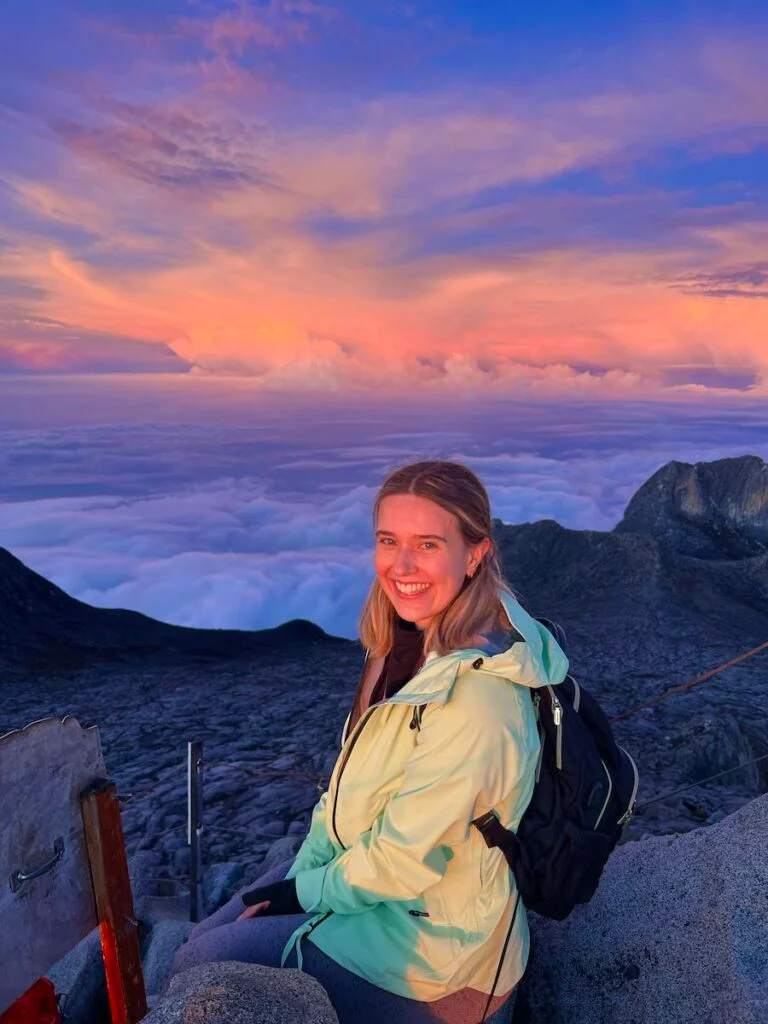
However, it more than exceeded those expectations, and the summit day was spectacular.
It’s a lot of altitude to cover in two days, so it’s not a walk in the park. For context, on the Manaslu Circuit Trek in Nepal, it took us 3–5 days of acclimatisation to reach anywhere near 4,000 metres.
On Kinabalu, you do that in two. That’s what makes it intense, but also what makes it so rewarding.

That’s also why a guide is mandatory. My guide, Cornelius, was clearly a pro and incredibly reassuring throughout.
What Surprised Me The Most
- There are proper beds at base camp (not basic mats).
- Base camp serves full buffet meals, including hot food and two breakfasts for summit day.
- There are cold showers — not fun, but available.
Who Mount Kinabalu Is Not For
I saw all ages on the mountain, from kids to older people, but climbing Kinabalu is not for everyone:
- If you’re uncomfortable using ropes: The summit section involves pulling yourself up rock using fixed ropes… in the dark. No technical skills needed, but it can feel challenging.
- If you like to hike slowly: There’s a time cut-off for reaching the summit at sunrise. Even at a fast pace, I only just made it in time.
- If you’re sensitive to altitude: You sleep at over 3,200 metres, with no gradual acclimatisation which increases the risk of altitude sickness.
- If you’re completely new to hiking: You don’t need to be an expert, but you should have some fitness base (stairs, incline walking, or smaller hikes beforehand).
The Main Ways to Climb Mount Kinabalu
1. Hiking Mount Kinabalu (2 days)
The traditional way to climb Mount Kinabalu is to do a two-day hike:
- On day 1, you’ll hike from Timpohon Gate (1,866m) to Panalaban Base Camp (3,272m), which takes around 5–7 hours.
- On day 2, you’ll start early, summit Low’s Peak, then descend all the way back to Timpohon Gate (with a short stop at base camp). Expect 8–10 hours of hiking in total.
Can You Hike Mount Kinabalu in Three Days?
When I hiked Mount Kinabalu, there was no option to hike over three days. However, they’ve now started offering a 3-day package with two nights at Panalaban Base Camp, which can help you with acclimatisation.
2. Hike With Via Ferrata (2 days)
You also have the option of summiting Mount Kinabalu using the via ferrata route (Mountain Torq). This is actually the world’s highest via ferrata.
- On day 1, you will hike with everyone else from Timpohon Gate to Panalaban Base Camp (around 5–7 hours.) You will sleep and receive a safety briefing at the Pendant Hut accommodation.
- On day 2, you take a different route to the Mount Kinabalu summit using the via ferrata route (around 3–4 hours). You then hike back down the mountain to Timpohon Gate (around 5–7 hours)
What Does the Mount Kinabalu Via Ferrata Involve?
The via ferrata is beginner-friendly, so no prior experience is needed. However, you must be over 10 years old and at least 1.3 metres tall.
You will be attached to the course by a harness and make your way over bridges, rungs and rails attached to the rockface by cable. It’s supposed to be a scenic but adrenaline-inducing route.
What It’s Actually Like (Traditional Two-Day Climb): Day-By-Day
I did the traditional two-day hike at Mount Kinabalu. Here’s what it was actually like.
Day 1: The Hike to Panalaban Base Camp
Day 1 begins at Timpohon Gate, at 1,866 metres, where the Kinabalu HQ is based. You’ll sign all the papers, rent hiking poles if needed and begin your hike.
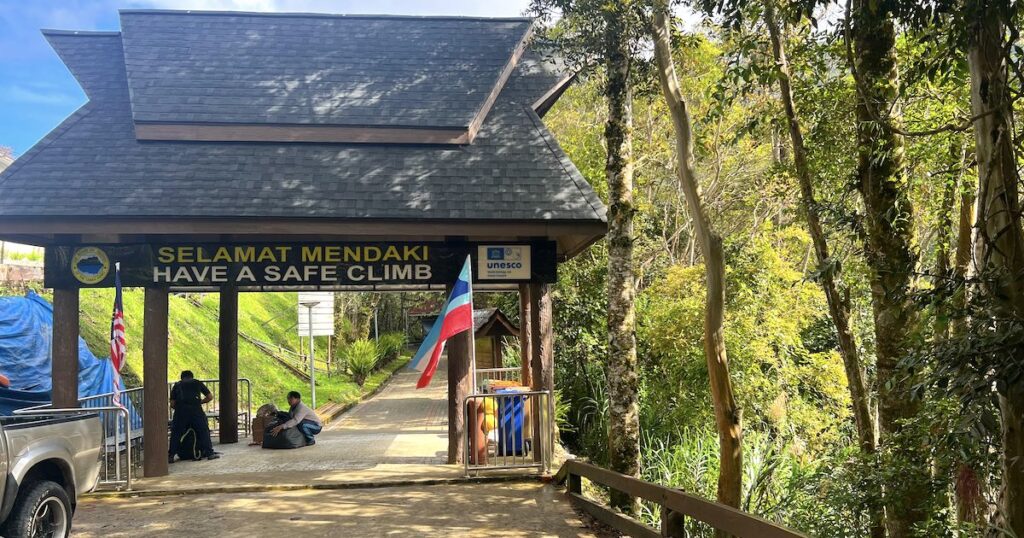
Getting to Timpohon Gate
- If you’ve booked the two-day hike, like me, you’ll arrive the same day by air-conditioned van (2.5 hours) from Kota Kinabalu. My van picked me up at 6:30am and we arrived at 8am.
- For three-day packages, you usually sleep near HQ.
The route to Tanah Rata Base Camp is along the Timpohon Trail, where there are 7 shelters along the way with benches and basic squat toilets (bring your own loo roll).
The trail is almost completely through a forest, where the vegetation rapidly changes with the elevation. Towards the top, you pass through a beautiful mossy forest before emerging at base camp.
The hike takes around 5–7 hours — and here’s the reality: it’s almost entirely uphill, with very few flat sections (even I was surprised).
It feels like climbing stairs for hours, just on dirt and rocks. And if it’s raining, it can be slippery.
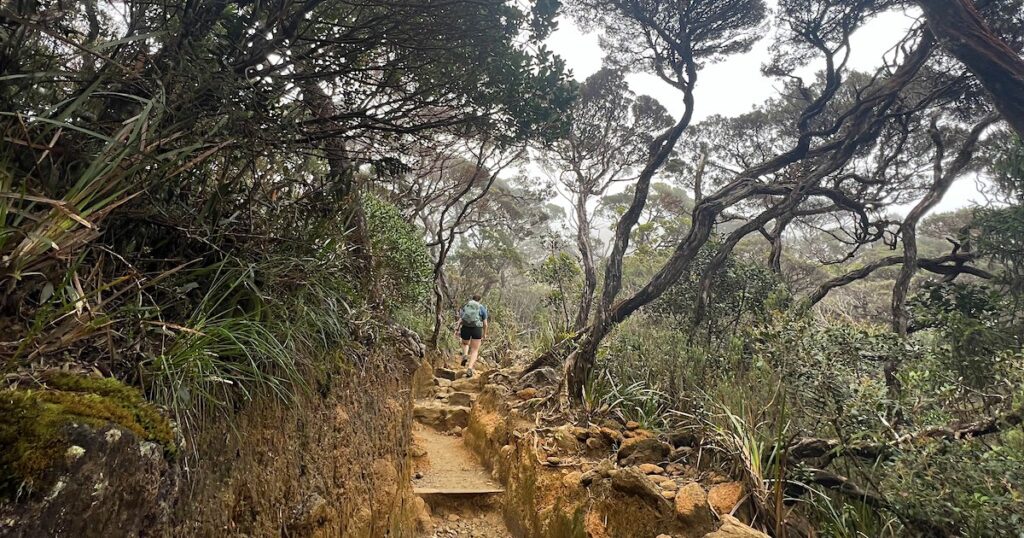
You don’t get much reward in terms of views; it’s all trees, except for one short open ridge.
I started the hike at 9am and arrived at Panalaban Base Camp at 2.15pm, so the trail took me just over 5 hours including breaks. That was a fairly quick pace compared to most hikers.
Once you arrive at base camp, you don’t need to do anything except rehydrate, eat dinner and go to bed early.

What Is Panalaban Base Camp Like?
- Different accommodation blocks depending on your package
- Dorms (3–6 bunk beds) or smaller private rooms
- Via ferrata climbers stay in Pendant Hut
- Large shared dining hall with a gorgeous outdoor terrace
- Cold showers and shared toilets
- Extensive buffet meals (including two breakfasts)
- Optional bar for drinks and snacks
- A small postbox (one of the highest in the world)
My group booked a basic package but we lucked out – because we arrived so early at base camp, and we were three females, they gave us a private room with two bunk beds.
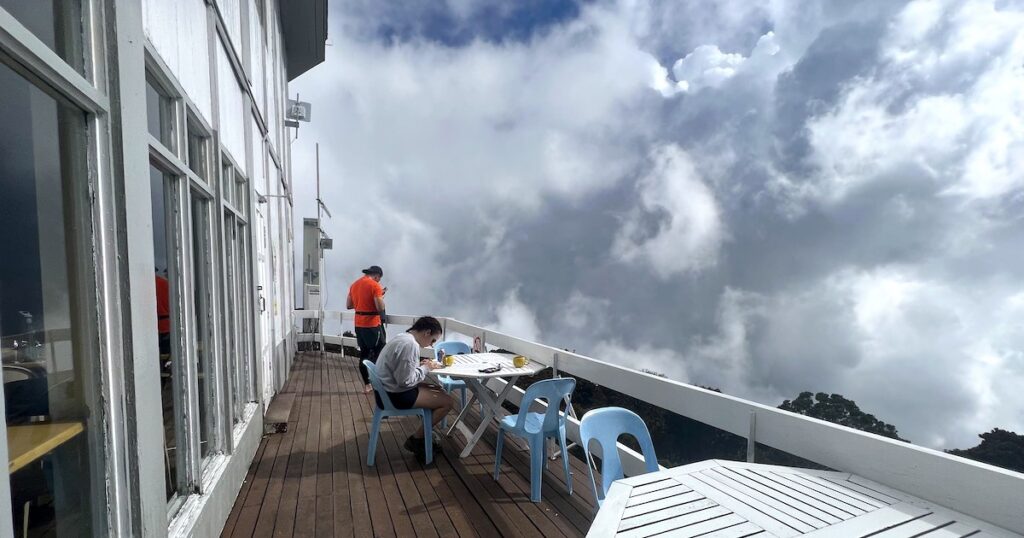
Day 2: Summit and Descent
The hike to the summit on day two begins at 2.30am – yes, really – so it’s worth sleeping early.
This is to make the most of the calmer weather in the night and early morning. The goal is to reach the summit for sunrise (typically at 6am).
On the day I hiked (in October), the sunrise actually started at 5.30am and it was already light by 5:50am. So, that gave us three hours to summit – we only just made it in time, with about 75% of hikers behind us.
The hike itself is challenging. The altitude plays a part (the air is thinner) but the darkness is what makes it feel more intense.
There are several sections where you need to pull yourself up rock using fixed ropes, all while hiking by headtorch.

The sunset at the summit is spectacular, albeit a bit crowded. Once the sun’s up, you really get to appreciate the descent back to base camp (2–3 hours).
It’s a dramatic, rocky mountain with large boulders and some lush green slopes towards base camp. This was my favourite part of the whole experience, and everyone was in a great mood.
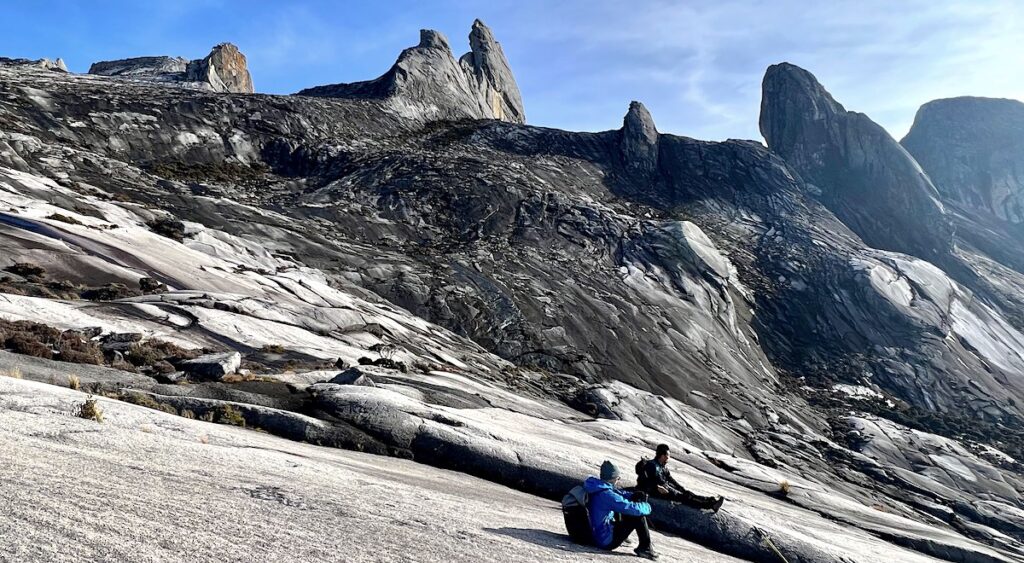
There’s no resting at base camp for long. All hikers descend back to Timpohon Gate on the same day (after a second breakfast buffet).
The final descent is very monotonous, hard on the knees and long, taking 5–7 hours. Unfortunately for us, it rained, so it was cold, miserable and wet. I found this the most difficult part of the trek, morale-wise.
How Hard Is Climbing Mount Kinabalu?
Climbing Mount Kinabalu is challenging, but it doesn’t require any mountaineering or technical experience.
It’s the combination of steep elevation gain, altitude, and long days on your feet that makes it tough.

Fitness Level
A good base level of fitness will be beneficial. The first day is essentially a long, continuous uphill climb (5–7 hours), and the second day is even more demanding: an early start, a steep summit push, and then a long descent all the way back down.
If you can comfortably:
- hike uphill for several hours
- handle lots of stairs (this is a big one)
- stay on your feet for 8–10 hours in a day
… you’ll be fine.
Before my climb, I’d done several smaller mountain hikes in Asia and trained with running and stairs, which helped a lot.
Altitude
You go from 1,866m to 4,095m in just two days, with only one night to acclimatise at around 3,200m.
Some people feel completely fine, while others experience symptoms like:
- headaches
- nausea
- dizziness
- shortness of breath
Personally, I didn’t feel the altitude at all but I started taking acetazolamide 2 days before the hike. If you’ve had severe altitude sickness before, you may want to re-think climbing Kinabalu.
Practical Information
How to Book The Mount Kinabalu Hike
Climbing Mount Kinabalu is tightly controlled, so you must book through a registered tour operator who will organise:
- Your climbing permit
- Accommodation at Panalaban Base Camp
- A mandatory guide
- Meals
If you’re planning to hike Mount Kinabalu in the peak season (March to September), it’s worth booking at least a few months in advance. Hiking spaces are limited.
I booked my two-day one-night hike with Amazing Borneo (not sponsored, just a happy customer). Everything went really smoothly.
Costs of Climbing Mount Kinabalu
It’s quite expensive to climb Mount Kinabalu, but once you actually get on the mountain and see the porters carrying food supplies, waste and other essentials up and down the mountain, you’ll realise why.
There are basic, standard and luxury packages (with private rooms) to choose from. Solo hikers pay the most; the more people in your group, the cheaper the cost of the climb per person.
- Standard 2D1N packages range from $305–600 for Malaysian nationals and $400–850 for international tourists.
- Via ferrata 2D1N packages range from $670–850 for Malaysian nationals and $790–970 for international tourists.
Tips
- Pace yourself: Don’t go faster than you need to. With the altitude, it’s much better to stick to a steady pace that feels comfortable for you. Rushing will only make the climb feel harder later on.
- Don’t underestimate how cold it is on the mountain: Yes, Sabah is hot and humid but Mount Kinabalu isn’t. Day one gets progressively colder (roughly 16°C down to 5°C), and the summit can feel freezing, especially before sunrise (often close to 0°C or below with wind chill). Good, insulating layers make a huge difference here.
- Pack light: You’ll need to carry your bag up to base camp, so avoid overpacking, especially heavier items like liquids. The summit push is lighter, as you’ll only take a small bag with essentials, but day one is where you’ll feel the weight most.
- Do train before the hike: I really recommend doing a few smaller hikes in the months leading up to your climb. Before Kinabalu, I spent four weeks in South Korea and climbed several mountains, which made it feel like a manageable step up rather than a shock to the system. Even regular stair climbing or incline walking will help a lot.
- Altitude sickness tablets: I picked up altitude sickness tablets from a pharmacy in Kota Kinabalu and started taking them two days before the climb. My friends started a day later and both felt quite headachey and nauseous near the summit, so I was glad I’d taken mine earlier. Everyone reacts differently, so it’s worth doing your own research or speaking to a professional before relying on them.
FAQs
Most people climb Mount Kinabalu over 2 days and 1 night. Day 1: Hike to Panalaban Base Camp (5–7 hours) Day 2: Summit at sunrise + descend back down (8–10 hours total). However, it’s also possible to stay 2 nights at Panalaban Base Camp.
Yes, a guide is mandatory. You cannot climb Mount Kinabalu independently, and your guide will stay with you throughout the hike.
Mount Kinabalu stands at 4,095 metres (13,435 ft) above sea level.
Overall, it’s considered a safe climb. However, risks include altitude sickness and slips on steep or wet terrain. Having a guide and following instructions makes a big difference. There have been fatalities on Mount Kinabalu, mainly during the 2015 Sabah earthquake which triggered a landslide.
The best time is typically March to September, when conditions are drier. That being said, weather can be unpredictable year-round. Clouds and rain are always possible.