Sabah Itinerary: One Week in Borneo, From Orangutans and Islands to Mount Kinabalu
Planning your Sabah itinerary should feel exciting, not stressful.
North Borneo is coated in miles of rainforest, home to orangutans, proboscis monkeys, crocodiles and sun bears – and, yes, you can see them even with just one week in Borneo.
That’s not all, either. Sabah has Mount Kinabalu (4,095 metres), one of Southeast Asia’s most beginner-friendly overnight mountain hikes.

If, like me, seeing orangutans is your top priority, this one-week Sabah itinerary includes the best places to look (on the Kinabatangan River cruise or Sepilok rehabilitation centre).
My Sabah itinerary is designed to help you prioritise the big experiences without trying to cram in everything. With one week in Borneo, you have time to visit Kota Kinabalu (and go island-hopping), hike Mount Kinabalu and look for orangutans and other wildlife.
This itinerary focuses on Borneo. If you’re planning a trip around mainland Malaysia, see my Malaysia itinerary – you can easily combine the two.
Disclosure: This post includes affiliate links. If you decide to click through and make a qualifying purchase, I will receive a small commission at no extra cost to you – thanks for your support.
Quick Overview: My One-Week Sabah Itinerary
Day 1 – Kota Kinabalu (Tribal villages, food, and markets)
Day 2 – Mount Kinabalu (climb or tourist park)
Day 3 – Mount Kinabalu (option to spend 1 extra day on the Kinabatangan River)
Day 4 – ✈️ Early flight to Sandakan. Kinabatangan River Day 1
Day 5 – Kinabatangan River Day 2. Drop-off in Sepilok. RDC night walk.
Day 6 – Sepilok orangutan and sun bear sanctuaries and the RDC. ✈️ Evening flight to Kota Kinabalu.
Day 7 – Island hopping from Kota Kinabalu.
Where is Sabah?
Sabah is the second-largest state in Malaysia, located in the north of Malaysian Borneo. The island of Borneo is split between Sabah and Sarawak (both Malaysian states) and Kalimantan (Indonesian Borneo).
Most people arrive in Sabah via Kota Kinabalu International Airport. The airport has direct flights to Kuala Lumpur, Seoul and several other international airports.
If you want to start your Sabah itinerary on the Sandakan Peninsula, the best place to see orangutans, you can also fly directly to Sandakan Airport from Kuala Lumpur.
What are the Main Tourist Attractions in Sabah?
There are several main tourist areas in Sabah, which I have plotted out on a map for your convenience.
- In West Sabah, you have Kota Kinabalu, where you can take trips to Mount Kinabalu and islands in the Tunku Abdul Rahman Marine Park.
- In East Sabah, you have the Sandakan Peninsula, home to Sabah’s orangutan and sun bear sanctuaries and the Rainforest Discovery Centre (RDC)
- Just below the Sandakan Peninsula is the Kinabatangan River, the best place to see wild orangutans, and the Danum Valley, excellent for wildlife safaris.
- Scattered off the east coast of Sabah are handfuls of islands (including Sipadan, Lankayan and the Turtle Island Park), famed for snorkelling and diving.
❗ Some foreign governments (including the UK) advise against all but essential travel to islands off the east coast of Sabah. This includes Sipadan, Lankayan and Turtle Island Park.
Is Sabah Worth Visiting – How Does it Compare to the Rest of Borneo and Sumatra?
Sabah is absolutely worth visiting for the wildlife alone. It’s a great place to see orangutans, wild (by boat on the Kinabatangan River) or semi-wild (on foot at the Sepilok sanctuary).
You can also spot the proboscis monkey, which is only found in Borneo.

Proboscis monkeys
If you’re wondering where to see orangutans in the wild, aside from Borneo, the only other place is Sumatra (Indonesia’s largest island).
I have seen orangutans in Borneo and Sumatra, and continue to rank Sumatra as the better destination.
In Sumatra, you must trek to see orangutans, which gets you up closer. It’s also far less crowded than Sabah. I write about my experience more in my Sumatra backpacking itinerary.
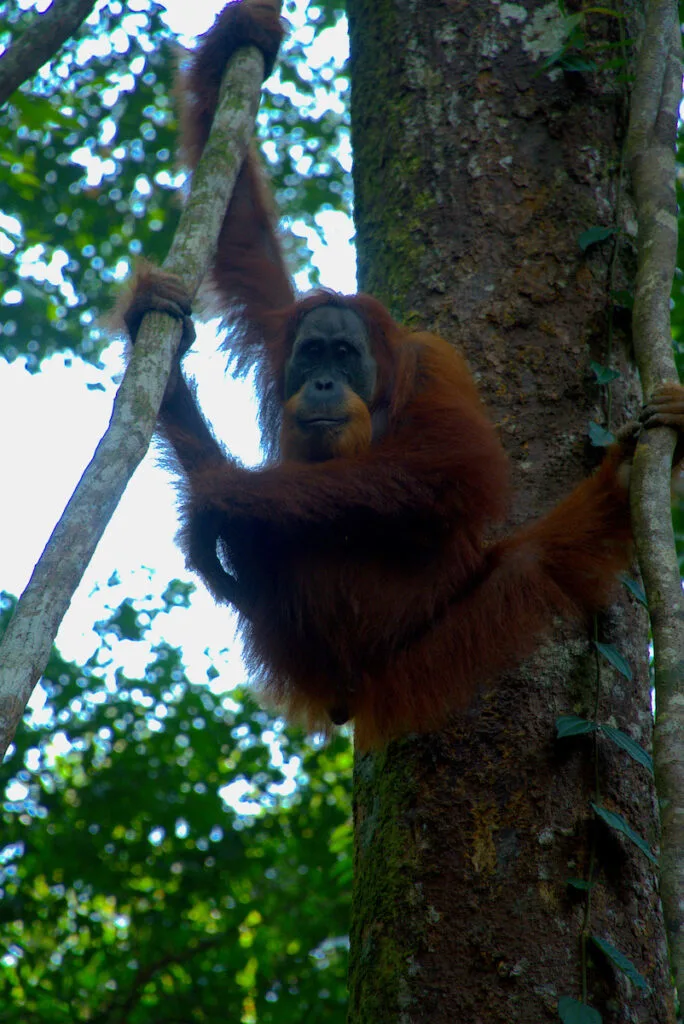
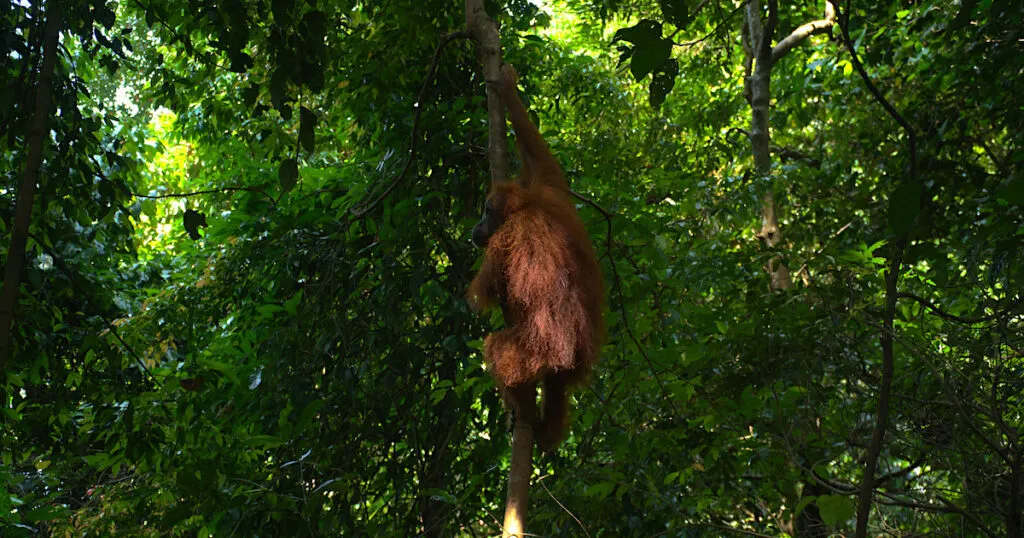
Orangutans I spotted in Sumatra
Elsewhere in Borneo, Sarawak (the other Malaysian state) only has one good orangutan rehabilitation centre, the Semenggoh Nature Reserve.
However, it’s very similar to the Sepilok sanctuary in Sabah: you watch and hope that the semi-wild orangutans attend the daily feeding sessions.
If you’re happy to go off the beaten track in Borneo, you can look for wild orangutans on a multi-day houseboat cruise in Indonesian Borneo (Kalimantan). I’m hoping to take this 4-Day Tanjung Puting National Park tour very soon; it has 140+ five-star reviews.
Briefly: My Sabah Itinerary Experience
I started my Sabah trip in Kota Kinabalu, where I arrived alone. I stayed at the hotel-hostel Toojou, which was frankly perfect for me as a solo traveller: it has an on-site restaurant and co-working space, and is centrally located.
I had a fair bit of writing weighing on me, so I busied myself in the co-working space, breaking only to visit a local gym, cafés, markets and the Monsopiad Heritage Village.
After several days, I was joined by two friends, and we began our one-week Sabah itinerary. Our first activity was a two-day hike to the summit of Mount Kinabalu (4,095 metres).

We booked the 2D1N hike with Amazing Borneo, and spent an incredible two days hiking (including sunrise at the summit), staying overnight at the Laban Rata resthouse.
There was no time to rest after our climb. The very next morning, we took a flight to Sandakan, where we were picked up by a minivan at the airport to begin our two-day Kinabatangan River cruise.
Split in half by one night at a jungle camp (hotel), we went on two boat cruises (evening and morning) and spotted proboscis monkeys, macaques and saltwater crocodiles – no orangutans or pygmy elephants, unfortunately.
No matter. I’d counted on this happening and booked us a two-night stay at Borneo Sepilok Rainforest Resort.
The first morning, we walked directly to the Sepilok Orangutan Rehabilitation Centre and promptly saw 6-10 orangutans at the 8am feeding session.
We then headed next door to the sun bear sanctuary. We had also planned to visit the RDC for a guided night walk, but too tired from our hike, we chilled by the hotel pool instead.

We also took a tour to Labuk Bay, but I regretted our decision after finding out that it was owned by a palm oil plantation, an industry that drives deforestation and displaces many animals.
Finally, we took a flight back to Kota Kinabalu to round off the trip with some island hopping and parasailing.
Sabah Itinerary: How to Spend One Week in Borneo
Before I jump into the full Sabah itinerary, I’ve provided a quick overview.
While you can follow it word for word, you don’t have to – for example, you might want to spend longer on the Kinabatangan River or swap out Mount Kinabalu for two nights in the Danum Valley.
Day 1: Kota Kinabalu
Highlights: Cultural villages, food, sunset and markets.

Kota Kinabalu is a good place to begin your one week in Borneo, as the largest and best-connected city in Sabah.
While it’s not the highlight of a Sabah itinerary, it has plenty to offer, including markets, sunset beaches and cultural villages that provide an insight into Borneo’s indigenous tribes.
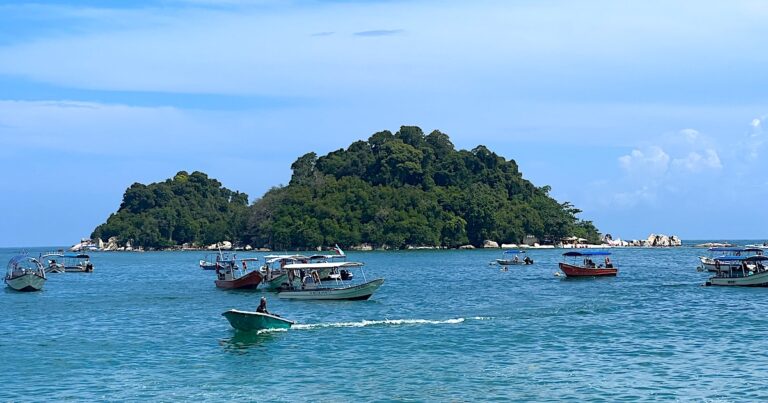
You can go island hopping in the Tunku Abdul Rahman Marine Park (home to five islands), although I have saved this for the final day of the itinerary.
Day 1 summary:
- Mari Mari cultural village (10am)
- Brunch at Woo!
- Kota Kinabalu Floating Mosque (2pm)
- Monsopiad Heritage Village (3.30 pm)
- Markets and sunset beach
1. Tribal villages – Mari Mari or the Monsopiad villages
If there’s one must-do activity in Kota Kinabalu, it’s visiting a cultural village.
The most popular is the Mari Mari Cultural Village, where you can learn about traditions and customs of Sabah’s indigenous tribes through tours (two daily) and activities.
I made the decision to visit the lesser-known Monsopiad Heritage Village instead, which is closer to the city and easy to reach by Grab taxi.

It focuses on the Kadazan-Dusun warrior Monsopiad and includes the House of Skulls, a collection from the region’s headhunting era.
I was also able to try blowpipe shooting and fire-making, try sago worm, and watch a traditional dance performance.
2. Food, markets and cafés
Kota Kinabalu has a great food scene, especially for seafood and local dishes like ngiu chap. There are several markets in the evenings for street food and fresh fruit: Night Food Market, Gaya Street Market and the Durian Night Market.
If you’re into cafés, I liked Woo! — I ended up spending an hour there with an iced coffee and nasi lemak (the national dish!) before moving on.

3. Kota Kinabalu Floating Mosque
The Kota Kinabalu Floating Mosque is one of the city’s most recognisable landmarks, set beside the water.
It’s about a 20-minute drive from the centre, and as it’s an active place of worship, you’ll need to dress modestly when visiting.

4. Massage and sunset locations – hiking prep!
If you’re heading to Mount Kinabalu next, this is a good time to slow down. I had a couple of foot and calf massages at New Borneo Family Reflexology, which felt very necessary before the hike.

For sunset, head to the waterfront or Tanjung Aru Beach.
Good places to stay

Hyatt Centric Kota Kinabalu (£££)

Toojou Kota Kinabalu (£££)
I stayed here!
Day 2-3: Mount Kinabalu
Highlights: Hiking and via ferrata
There are two main ways to experience Mount Kinabalu, Malaysia’s highest mountain at 4,095 metres.
You can climb it (with a two-day hike, including the option for via ferrata). Or you can visit the ground-level tourist park, cattle farm and hot springs.
I’m going to begin with the hike, which is what I chose to do.
1. Hiking Mount Kinabalu
If you’re considering hiking Mount Kinabalu while you’re in Sabah, I’ve written a full guide to climbing Mount Kinabalu covering how to book it, what it’s like, and whether it’s worth it. But here’s a brief overview.
Climbing Mount Kinabalu typically takes 2 days and 1 night, accompanied by an experienced mountain guide.
I took the standard 2D1N hiking tour (without via ferrata) with Amazing Borneo. However, you can also do the 2D1N via ferrata (a challenging route where you’re harnessed in and climb using rungs, rails, cables and bridges).
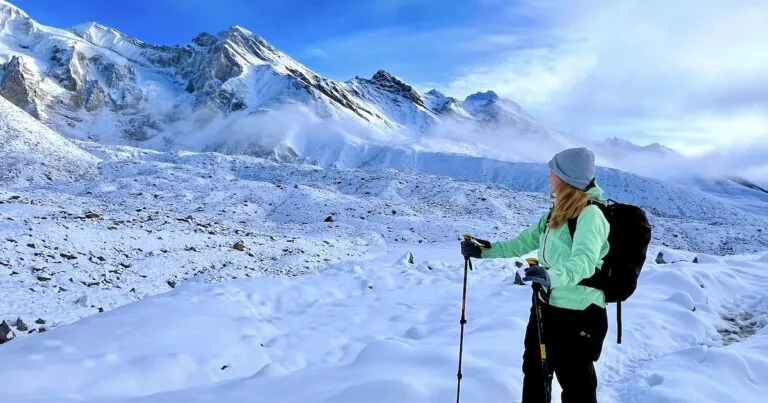
On the first day, we climbed from Timpohon Gate (1,866 metres) to Panalaban Base Camp (3,272 metres), a hike that takes most people around 5–6 hours.

At base camp, we had a delicious buffet dinner at Laban Rata Guesthouse – food is carried up the mountain daily by porters – before getting a quick sleep before the sunrise summit climb.
The aim was to reach the Mount Kinabalu summit (4,095 metres) by sunrise, which should take around 3–4 hours. The air is thin and the hike challenging (including rope-assisted sections), but the views are spectacular.

After making it to the summit, the hike down to base camp is spectacular in the daylight. A buffet breakfast awaits at the guesthouse to prepare you for the challenging hike back down to Timpohon Gate.
If you have the means to hike, I highly recommend doing it. It was my favourite part of my Sabah itinerary – and worth the cost.
2. Visiting the Mount Kinabalu Tourist Park
If you’re not keen on the idea of hiking – who can blame you? – then you can do the laidback Kinabalu Park tour instead.
You only need one day to do this, which means that you can either fly to Sandakan one day early to spend an extra day on the Kinabatangan River or stay in Kota Kinabalu for island-hopping.

The Kinabalu Park tours follow a pretty standard itinerary, beginning at the Pekan Nabalu weekly market to try local fruits before taking a short guided walk in Kinabalu Park, which overlooks the mountain.
They then stop by the Desa Cattle Dairy Farm to see the cattle graze in lush, green fields below the mountain and try the farm’s milk and cheese.
Some tours also visit the Poring Hot Spring, a sulphur-rich natural spring in lowland forest with a butterfly farm and two waterfalls. Most tours won’t include the two-hour trek to the waterfalls, sadly.
Day 4 – 5: Kinabatangan River (Sandakan) and the RDC
Highlights: Orangutans and wildlife-watching
The Kinabatangan River is the best place to see wild orangutans and proboscis monkeys in Sabah – and therefore a must on any Sabah itinerary.
To get there, you’ll need to take a flight from Kota Kinabalu to Sandakan, and then start a pre-arranged tour.

While there are many macaques and proboscis monkeys at the river, wildlife such as orangutans, pygymy elephants and saltwater crocodiles are a little more elusive.
Therefore, I explain in my detailed guide to the Kinabatangan River cruise, the longer your tour, the greater your chances of spotting wildlife.


The overnight river cruises include accommodation at ‘jungle camps’ along the river, which are technically just rustic hotels with frequent monkey visitors at mealtimes.
If you’re following my itinerary, you’ll need to take the 2D1N river cruise (available as a group tour or the private tour) to do 2-3 cruises and one night in a ‘jungle’ hotel. Have an extra day spare? The 3D2N tour is even better: it fits in 5 cruises.
In total, on my 2D1N cruise, I spotted 15+ proboscis monkeys, 2-3 saltwater crocs, egrets, storks and so many macaques I lost count.


Another great part about the river tours is that they will drop you off at any hotel in the Sandakan or Sepilok area, which makes getting to the next destination easy peasy.
Extra activity: Night walk at the Rainforest Discovery Centre
Once you have been dropped off at your Sepilok hotel, on day 5 of this Sabah itinerary, you should have time to go on a night walk at the Rainforest Discovery Centre (RDC).
The night walks (every day from 6pm to 8pm) give you the chance to explore the forest after dark with a wildlife guide armed with red lights.
The night walks must be pre-booked on the RDC social media or in-person at the ticket office, so you will need to plan ahead to fit this in.
Good places to stay

Borneo Sepilok Rainforest Resort (£££)
I stayed here!
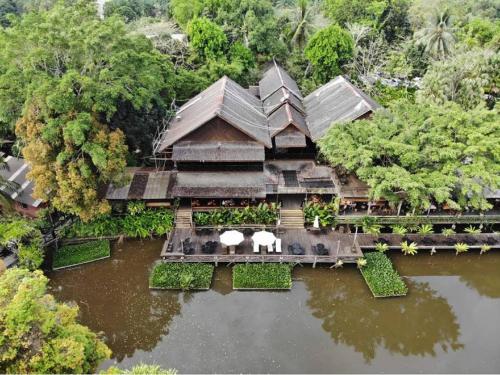
Sepilok Nature Lodge (£££)
Day 6: Sepilok
Highlights: Orangutans, sun bears and rainforest.
1. Sepilok Orangutan Rehabilitation Centre
Entry fee (foreigners): RM 30 (adults) or RM 15 (children).
We’re coming near the end of your one week in Borneo, which I have carefully planned out just in case you weren’t lucky enough to see orangutans on the Kinabatangan River.
The penultimate day requires another early start. You need to reach the Sepilok Orangutan Rehabilitation Centre at 7:30am to get your tickets and walk 15 minutes along the boardwalk to the 8am orangutan feeding session.
If you’re not a morning person, you’ll probably want to stay next door at the Sepilok Nature Lodge. I stayed at Borneo Sepilok Rainforest Resort, which is only a 20-minute walk away.

The Sepilok Orangutan Rehabilitation Centre is a non-profit organisation that supports displaced, captured and orphaned orangutans in Sabah.
All of the profits go towards the orangutans, who roam freely in the forest to re-learn foraging and nest-building behaviours from the more experienced orangutans at the centre.
The sanctuary supports their foraging activities with two daily feeding sessions (at 8am and 3pm). These are the best times to see orangutans, as they descend upon the food from the surrounding forest.

Sightings are never guaranteed, but during the dry season (April to September), your chances are the highest.
Mornings are also better because orangutans are more likely to be hungry from their overnight fast.
The indoor feeding platform provides an air-conditioned space to watch the orangutans eating. I saw around 5 orangutans through the glass.

At approximately 10am, the loudspeakers announce the beginning of the feeding session at the outdoor platform, which is located on the walk back to the entrance.
This is a better experience overall, as the rangers spread food out in the open.

The monkeys and orangutans climb right overhead the viewing platform using the ropes strung between the trees.
If you would prefer to have all transport logistics organised for you, this full-day Sepilok tour visits the sun bear and orangutan rehabilitation centres and the RDC.
2. Bornean Sun Bear Conservation Centre
Entry fee (foreigners): RM 50 (adults)
The Bornean Sun Bear Conservation Centre (BSBCC) is right next door to the orangutan sanctuary, so you only need to cross the road and you’re ready to see yet another iconic Borneo animal.
Just like the orangutan sanctuary, the BSBCC is a non-profit organisation dedicated to rehabilitating its residents. It’s home to the smallest bear species on the globe, the Malayan sun bear.

They really are tiny, even up close. I watched them scuffle and sniff around their enclosures from the wooden boardwalks, taking note of the information on the placards.
The centre was not as busy as the orangutan centre, which made it all the more enjoyable. I was in and out in around 45 minutes.
3. Lunch break at Sepilok Nature Resort
Wildlife-watching is hard work. By now, you’ve been on your feet all morning, and you’re probably looking to find somewhere to refuel.
That’s the state I found myself in at 12pm. I didn’t want to walk back to my hotel for lunch, so we instead headed next door to the Sepilok Nature Resort restaurant.

Adjoining the hotel, the restaurant overlooks the forest, where, if you’re very lucky, you might spot orangutans.
Eating here was just what we needed. In fact, the food was so good, we returned for a second day in a row, and re-ordered the same dishes: beef rendang (a classic Malay dish), freshly-squeezed juice and barista coffee.
4. Rainforest Discovery Centre (RDC) nature walks and Canopy Skywalk
Entry fee (foreigner): RM 30 (adults)
If you didn’t get to see orangutans at the morning 8am feeding, you might want to head back to the Sepilok Orangutan Rehabilitation Centre for the 3pm feeding session.
Otherwise, you can spend the remainder of the afternoon at the Rainforest Discovery Centre (RDC), which is open from 8am to 5pm daily.
Set within the lush, green Kabili-Sepilok Forest Reserve, the RDC has nature trails and a Canopy Skywalk 20 metres off the forest ground.
Some lucky guests have seen orangutans gliding through the forest reserve. However, you’re more likely to spot animals like the sunbird, mouse deer and macaques.
✈️ Here, you’ll need to book the 7.20pm Air Asia flight from Sandakan to Kota Kinabalu to spend the next (and final) day island-hopping in Kota Kinabalu. You only need to get to the airport around 2 hours before departure.
If you’re planning to visit Sandakan and Sepilok for the orangutan sanctuaries, I’ve put together a full guide to things to do in Sandakan and Sepilok covering how to get there, where to stay, and what to expect.
Day 7: Island-hopping in Kota Kinabalu
Time needed: 1 day
Highlights: Island-hopping, watersports and snorkelling.
That brings us to the final day of your Sabah itinerary, which I’ve reserved for island-hopping from Kota Kinabalu.
The Tunku Abdul Rahman Marine Park has five islands, with Manukan and Mamutik being the most popular.

Tours typically depart early in the morning from Jesselton Point Ferry Terminal, so you’ll need to be back in Kota Kinabalu the evening before (I took the 7.20pm AirAsia flight from Sandakan).
If you’re keen on snorkelling, it’s worth choosing a more structured tour with good reviews. If you’re after a relaxed beach day, a simpler island-hopping tour works just as well.
I booked the Long Beach (Package B) tour, which visits Manukan and Mamutik Island.
1. Manukan Island
Manukan was my favourite island in the park: clear turquoise water, white sand and palm trees as you arrive.
We spent the morning doing watersports (parasailing and a banana boat), which I wasn’t expecting much from, but the views back over the Kota Kinabalu skyline were actually really good.
After that, we had some free time to swim, relax and grab lunch by the beach.


2. Mamutik Island
The final stop was Mamutik Island, which is closer to the city and a bit busier. The beach isn’t quite as striking as Manukan, but it’s still a nice place to unwind for a couple of hours before heading back.

If you have an extra day available for your Sabah itinerary, you have the option to stay on the islands themselves.

Bunga Raya Island Resort & Spa (£££)

Gaya Island Resort (£££)
Five Days in Sabah: What Should You Prioritise?
If you have only five days in Sabah, you won’t have time to do everything on the itinerary.
- If you want to see orangutans, go directly to Sandakan and take a 3D2N tour of the Kinabatangan River. On day 4, spend one night in Sepilok to visit the wildlife sanctuaries and the RDC. On the final day, take a flight to Kota Kinabalu to explore the city and visit the cultural villages.
- If wildlife is just a bonus, go directly on the Mount Kinabalu hike from Kota Kinabalu (2D1N). After climbing Mt Kinabalu, fly to Sandakan for 1 day to visit the Sepilok wildlife sanctuaries or do a one-day Kinabatangan River cruise. Spend the final day island-hopping in Kota Kinabalu.
4 Must-Knows Before Your Sabah Itinerary
There are a few things that I think everyone must know before visiting Sabah.
1. Orangutan sightings aren’t guaranteed – but you can maximise your chances.
Firstly and perhaps most importantly, it’s important to bear in mind that orangutan sightings are never guaranteed, whether it’s wild orangutans on the Kinabatangan River or the semi-wild rehabilitated orangutans in Sepilok.
Orangutans are wild animals, so their behaviours are not predictable.

There are ways that you can boost your chances of spotting wild orangutans, and that’s visiting during the dry season when they are more likely to rely on the Kinabatangan River as a water source.
On the Kinabatangan River, the longer the tour, the more chances you have to spot orangutans too. That’s why I always recommend spending at least two days, but preferably three, on the river.
2. The Mount Kinabalu hike must be booked in advance.
I’m all about making last-minute plans based on first-hand recommendations.
However, for some activities in Sabah, this is just not realistic – particularly the Mount Kinabalu hike or via ferrata tours, which sell out several months in advance.

The park has a cap on the number of daily visitors. Therefore, a limited number of climbing permits are awarded to hikers and climbers.
Climbing Mount Kinabalu is a bucket-list experience for many Malaysian nationals and foreigners, so make sure to look at the tour availability in advance.
The Best Time to Visit Sabah
The best time to visit Sabah is from April to September, the dry season.
The driest months are May, June and July. The rain starts to increase around September and October (‘the shoulder season’).

I carried out my Sabah itinerary in October, the shoulder season, to avoid the crowds. I was lucky, as it stayed dry most of the trip and I only experienced a couple of downpours.
I hope you found my Sabah itinerary helpful. Leave a comment below to let me know your trip plans – and whether you were lucky enough to see orangutans.