Where to Stay on Jeju Island With or Without a Car: Honest Review of the Best Areas
Choosing where to stay on Jeju Island sounds straightforward, until you find yourself three bus transfers away from your favourite beach.
South Korea’s largest island, Jeju, has two cities, seven towns and 31 neighbourhoods. Driving from east to west takes around two hours, and if you’re relying on public transport, it’ll take even longer.
Where you stay on Jeju Island really matters. I explored the island first-hand for two weeks, so I’ll give you an honest look at the best areas to stay in Jeju with or without a car.
I’ll also cover where to stay for beaches or watching the island’s famous Haenyeo divers in action.
Disclosure: This post includes affiliate links. If you decide to click through and make a qualifying purchase, I will receive a small commission at no extra cost to you – thanks for your support.
Quick Guide to the Best Areas on Jeju Island
It’s best to think of Jeju Island as a pie, split into four sections: north, east, south and west. In the middle is Mount Hallasan, the highest mountain in South Korea.

Most tourist attractions are scattered along the southwest to southeast corridor, so Seongsan and Seogwipo are good places to stay.
Both of these places have decent bus connections to each other, the Mount Hallasan trails, and beaches.
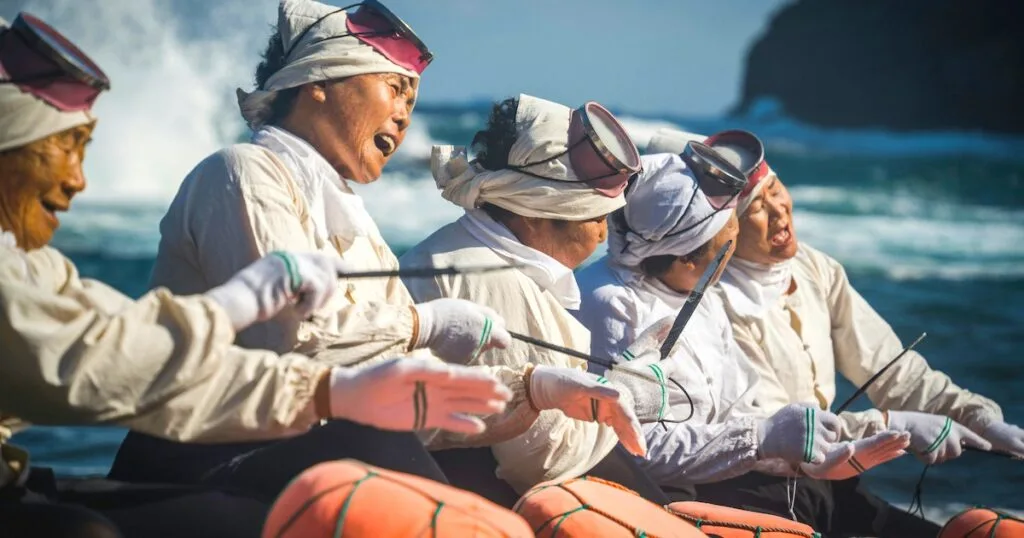
In Seongsan, you can climb Seongsan Ichulbung, watch a demonstration by the island’s famous Haenyeo divers, and take the ferry to Udo Island.
In Seogwipo, you can easily visit waterfalls, get to the Mount Hallasan trails quickly by bus, and visit the traditional market, coffee shops and restaurants.

Here’s a quick, convenient overview for north, east, south and west Jeju:
- North Jeju is best for accessing the airport.
- It’s home to the airport and Jeju City.
- It’s well-connected by public transport, but you may find the city itself boring.
- For beaches, consider staying around Hamdeok Beach (northeast).
- East Jeju is a great place to stay.
- Seongsan has a small mountain and Haenyeo demonstrations.
- You can take the ferry to Udo Island.
- It’s only a 20-minute bus from Sewha Beach.
- South Jeju is an excellent base if you’re not renting a car.
- Seogwipo, the second biggest city in Jeju, has great bus links.
- You can quickly reach the Mount Hallasan trails by bus.
- Easily visit waterfalls, coastal walks, and natural pools.
- It’s far from beaches: Jungmun Saekdal Beach is an 80-minute bus journey.
- West Jeju is best for a beach holiday.
- The Yongmeori Coast is spectacular.
- Hyeopjae Beach is one of the best beaches in Jeju.
- However, you’re far from Seongsan and Mount Hallasan.
Where to Stay on Jeju Island With a Car
If you’re planning to rent a car to explore Jeju Island – easily done using the sites Discover Cars and Klook – you don’t have to consider where to stay too hard.

As I mentioned earlier, it takes two hours to drive from east to west. It also takes a similar amount of time to drive from north to south.
Therefore, wherever you stay, most destinations will be within a two-hour drive.
The best place to stay on Jeju Island with a car is anywhere between Seogwipo and Seongsan.
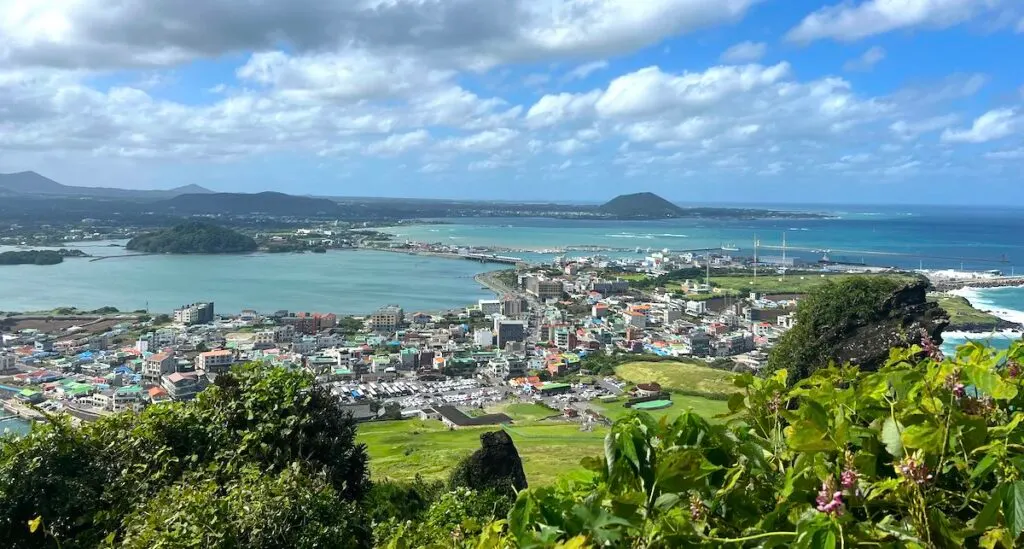
Seongsan
However, one of the best parts about having a car is that you’re free to hop between multiple bases without worrying about bus connections.
Here’s a sample itinerary that could work beautifully:
- Hamedeok Beach (northeast Jeju): 1 night
- Seongsan (east Jeju): 2-3 nights
- Seogwipo or Yeongmori Coast (south/southwest Jeju): 2-3 nights.
Where to Stay on Jeju Island Without a Car
If you’re not renting a car, the best places to stay are Seongsan and Seogwipo – ideally both, one after the other.
Seongsan and Seogwipo are 80 minutes away from each other by bus, so it makes sense to visit them individually.
I often see Jeju City recommended to tourists, but aside from being near the airport, it’s quite far from everything else.
I stayed in Seogwipo for two weeks and easily took the bus to Mount Hallasan, Seongsan and beaches on the west of the island.
This sample itinerary works beautifully without a car:
- Seongsan (east Jeju): 2 nights
- Seogwipo (south Jeju): 2-3 nights
The Finer Details: Where to Stay on Jeju Island
1. Where to Stay in Seongsan (East Jeju)
How to get to Seongsan by bus
- From the airport: Bus 111 (80 minutes) from outside Gate 2.
- From Seogwipo: Bus 201 (85 minutes) from Dongmun Rotary bus stop.
You can’t go wrong with Seongsan, whether you’re looking at where to stay in Jeju with or without a car.
Seongsan-ri town sits at the bottom of Seongsan Ichulbung (Seongsan Sunrise Peak), a small mountain with a large volcanic crater.
It has a laidback vibe, with a few handfuls of coffee shops, Korean restaurants and guesthouses.
The trick is to stay as close to Seongsan Ichulbung as possible; these hotels have the best views and easy access to bus stops.
Directly from the town, you can walk to the bottom of the trail to Seongsan Ichulbung. It takes around 20-30 minutes to reach the top; sunrise hikes are particularly popular.
At the bottom of the mountain is a black-sand beach, where a group of the island’s famous Haenyeo (female free divers) perform a daily demonstration at 2pm.
From Seongsan, you can also catch the ferry to Udo Island, popular for its fishing villages, electric buggies, black lava cliffs, beaches and peanut-flavoured food.
You may also want to visit the Jeju Haenyeo Museum at Sewha Beach, accessible via bus line 201 or 101, in 20 minutes.
Between February and May, many people take photographs at the sunny yellow Seongsan Canola Flower Field.
The thing is, Seongsan is quite small. Once you have ticked off the main things to do, you can quickly grow bored. One or two nights is the sweet spot.

Haeilri Pool & Spa Hotel (£££)

Breeze Bay Hotel (£££)

Hu An Stay Hotel (£££)
2. Where to Stay in Seogwipo (South Jeju)
How to take the bus to Seogwipo
- From the airport: Bus 600 from Gate 5.
- From Seongsan: Bus 201.
I stayed in Seogwipo for two weeks. As Jeju’s second largest city, it’s well-connected by public transport and has plenty to do, from restaurants and shops to waterfalls, coastal trails and sightseeing.
The best place to stay in Seogwipo is the area around Lee Jung Seop Street. Seogwipo is a fairly hilly city, so anywhere below Lavarr coffee shop is good.


I spent most of my time in Seogwipo at Jeju Hiking Inn (Gudeok Guesthouse), a hostel above the harbour.
I adored the location and the owners, who were instrumental in helping me to book my Mount Hallasan hike. Along with my main hotel recommendation, Hotel Yeon, the guesthouse is right next to the steps down to the harbour and Cheonjiyeon Waterfalls.
It’s also across the road from my favourite coffee shop, Cafe Jun, which overlooks the harbour.

Towards the end of my stay, I ended up moving to a larger room at HY Choi Hostel, as – travelling with my partner – we found the room too small for a long stay at Jeju Hiking Inn.
Although this hostel is a little further up the hill from the harbour, the rooms are very spacious and it has a large communal area.
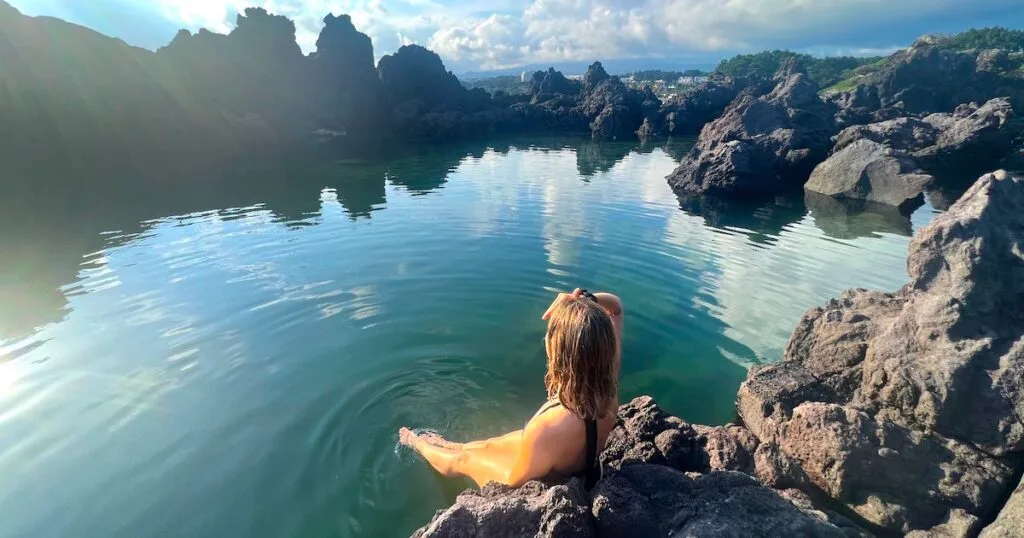
Here are some tips for staying in Seogwipo, from someone who stayed there for two weeks:
- My favourite coffee shops are Cafe Jun and Woody Glade, and you must try the local snacks at Seogwipo Maeil Olle Market (open since the 1960s).
- Try walking along the Jeju Olle Trail to Socheonji, a series of gorgeous (and quiet) natural pools.
- The 520 bus from opposite Yudong Coffee goes to Jungmun Saekdal Beach in 1 hour – get off at Byeol Naerin Observatory.
- To reach Seongsan, take the 201 (for 85 minutes) from Dongmun Rotary bus stop.

GoldOne Hotel & Suites (£££)

Hotel Yeon (£££)

HY Choi Hostel (£££)
I stayed here!
3. Where to Stay in Jeju City (North Jeju)
Jeju City is conveniently located next to the airport. It’s good for a quick overnight stop if you’re arriving on a late flight.
Most of the higher-end hotels are located in the area south of the airport, near Nuwemaru Street (Pedestrian Shopping Street). However, many reviews say this area feels quite touristic.
If I were going to stay in Jeju City, I’d base myself somewhere near the Dongmun Traditional Market, the Jeju Folklore and Natural History Museum and Jejumok Gwana.

Grand Hyatt Jeju (£££)

Ventimo Hotel & Residence Jeju (£££)

Elin Hotel (£££)
4. Where to Stay on Jeju Island for Beaches
If you’re visiting Jeju purely for the beaches, Seogwipo and Seongsan are not the best choices. Instead, look towards these directions on the west and north of the island:
A) Hamdeok Beach (North Jeju)
Hamdeok Beach is the easiest beach to get to from Jeju City; take bus no. 325 directly from the airport and you’ll be there in around 50 minutes.
Lined with palm trees and white sand, it has access to trails like Jeju Olle Trail Course 19 and the walk up Seoubong Volcanic Cone.
The promenade does give off ‘beach resort vibes’, as it’s next to a main road and lined with snack stalls. During the summer, the beach gets quite busy, as it’s the nearest one to Jeju City.

Ocean Grand Hotel (£££)
B) Hyeopjae Beach (West Jeju)
Hyeopjae Beach is located on the west side of Jeju, and has spectacular views over Biyangdo Island. It looks emerald in the morning light and pink at sunset when the conditions are just right.
Again, it’s quite a popular beach, so it can be crowded during the summer. There are lots of resorts in the area behind the beach, so there are plenty of options as to where to stay.
The Hallim Park botanical garden is also nearby.
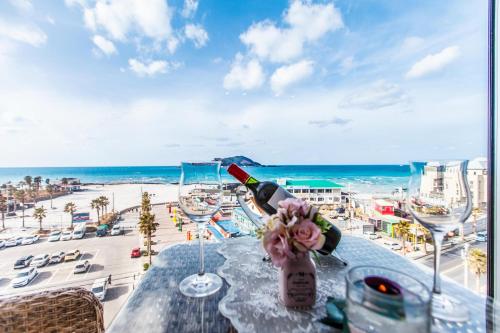
Blue Spring Boutique Hotel (£££)
C) Yeongmori Coast (South Jeju)
The Yeongmori Coast is further away from the airport, at the southwest end of the island. It’s not really a swimming destination, but well known for its dramatic volcanic rock formations and coastal walks.
The area is also home to Sanbangsan, a small but dramatic mountain with a seasonal canola field and the hilltop Sanbanggulsa Temple.
Most people relax at Hwasun Golden Sand Beach, but it has views of the port and is not a swimming beach.

Maison Sanbang Jeju (£££)

Y Resort Jeju (£££)
I hope you found this guide to where to stay on Jeju Island useful – leave a comment below to let me know your trip plans. I’d love to hear from you!
Suggested reading:
- South Korea itinerary – start here!
- Seoraksan National Park hiking guide