Where to See Orangutans: Borneo or Sumatra? I Visited Both…
If you’re considering where to see orangutans in the wild or semi-wild, chances are that you’ll eventually find yourself weighing up two unforgettable destinations: Borneo or Sumatra.
Like many others, I had always dreamed of seeing orangutans in person – these magnificent great apes share about 97% of their DNA with humans.
However, there are only two places to see wild orangutans: Borneo, a large island split between Malaysia and Indonesia, and Sumatra, Indonesia’s largest island.
The problem with most online advice on where to see orangutans? It’s usually written by people who haven’t visited either destination first-hand.
That changes here. I’ve seen orangutans in Malaysian Borneo (in 2024) and Sumatra (in 2023), and I’m here to share my honest take.
I’ll walk you through the best places to see orangutans in Sumatra, Malaysian Borneo, and Kalimantan, with a clear pros-and-cons breakdown for each.
Disclosure: This post includes affiliate links. If you decide to click through and make a qualifying purchase, I will receive a small commission at no extra cost to you – thanks for your support.
Quick Summary: Where to See Orangutans
Wild orangutans are endemic to the rainforests of Southeast Asia. To see orangutans, you need to visit the islands of Borneo or Sumatra.
Tourists can see wild or semi-wild orangutans at national parks and rehabilitation centres in Sumatra (Indonesia), Sabah and Sarawak (Malaysian Borneo) or Kalimantan (Indonesian Borneo).
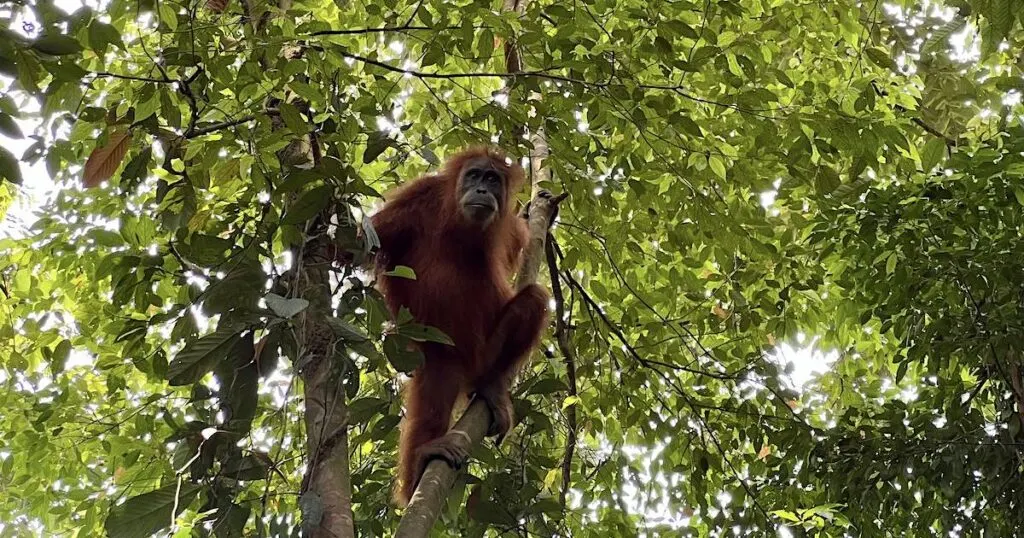
My first sighting of an orangutan. (Bukit Lawang, Sumatra)
There are three orangutan species, organised geographically:
- The Bornean orangutan, only found in Malaysian Borneo.
- The Sumatran orangutan, concentrated in North Sumatra.
- The Tapanuli orangutan, the rarest species, found only in South Tapanuli in Sumatra.
Below, I have plotted out a map of the main orangutan-spotting destinations in Sumatra and Borneo.
Sumatra Orangutans Map
Borneo Orangutans Map
Should You See Orangutans at the Zoo or in the Wild?
Many zoos around the world keep orangutans. However, if you have the chance to visit them ethically in their natural habitat, this is far better.
No matter how hard they try, zoos cannot directly replicate the orangutan’s natural environment.
Orangutans are supposed to live in tropical rainforests, where they can forage, build nests and relocate over long distances.
Zoo enclosures suppress these natural behaviours, inducing stress and boredom.
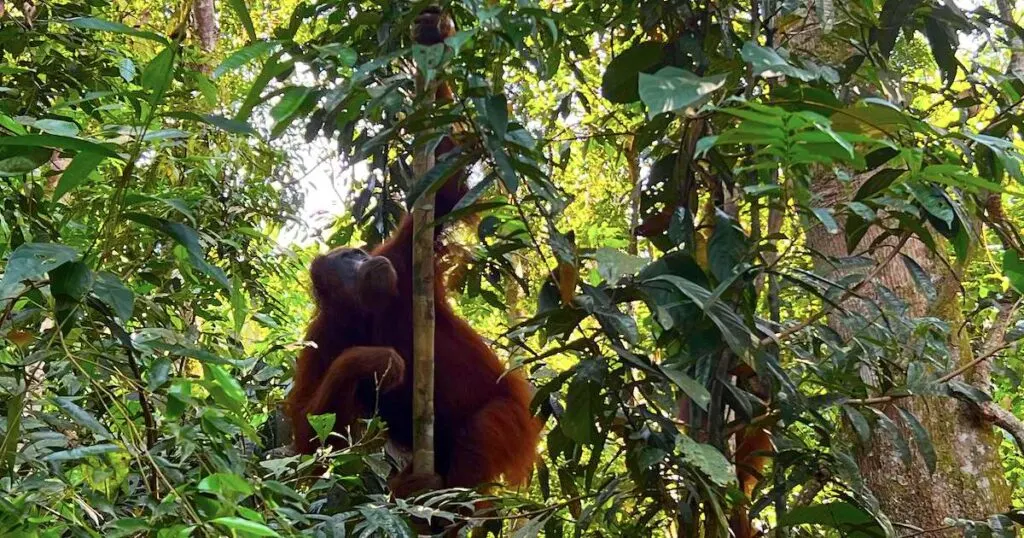
While many zoos run conservation and breeding programmes to create a ‘backup’ for the endangered species, it comes at a cost for their wellbeing.
I made the decision to boycott zoos and only visit animals in the wild/semi-wild – this ultimately led me to Sumatra and Borneo.
Seeing orangutans in the wild (or semi-wild) has several major benefits:
- It’s an authentic experience. You get to see natural behaviours like foraging and swinging through the trees.
- Supporting eco-tourism discourages activities and industries like logging, mining and palm oil, helping to conserve the rainforest and orangutans’ lives.
- It also supports the local economy, providing jobs to local people.
- It reinforces the importance of natural habitats and rainforest conservation.
How to Choose an Ethical Orangutan Experience
Orangutan treks and experiences should follow a few set standards.
Unethical practices can influence orangutans’ natural behaviours – discourage them from foraging, for example – or spread diseases.
- Wild orangutans should not be fed or touched by tourists.
- Group sizes should be small and kept at least 10 metres away from the animals.
- The orangutans should be quietly observed.
- Guides should not lure or track orangutans with food or other items (unless being fed as part of a rehabilitation programme).
- Orangutan wellbeing should be prioritised over everything else.
Where to See Orangutans in the Wild or Semi-Wild
1. Where to See Orangutans in Sumatra
Out of Sumatra and Malaysian Borneo, Sumatra was my favourite place to see orangutans.
I went orangutan trekking from Bukit Lawang in North Sumatra, after spending 2-3 weeks on the island on my Sumatra backpacking itinerary.
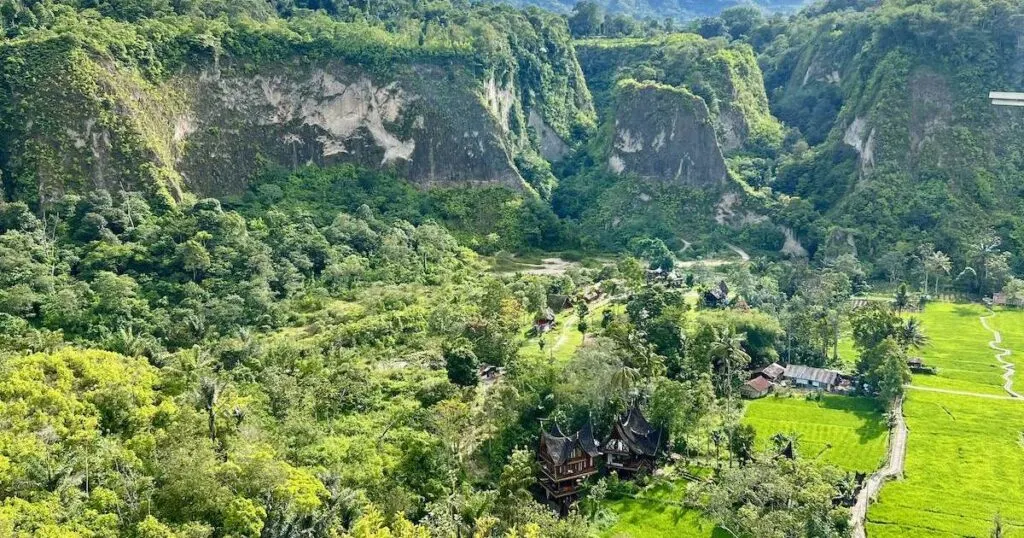
Why do I think it’s the best place to see orangutans? I’ll cover that in more detail later on… however, to summarise, it was far less crowded than Malaysian Borneo.
In Sabah (Borneo), I didn’t see any orangutans at the Kinabatangan River, despite booking a two-day tour.
When I finally saw them at the Sepilok Orangutan Rehabilitation Centre, I felt almost like I was at zoo. There were too many tourists for my liking, and most of the sightings were from behind a glass screen.
On the other hand, in Sumatra, I saw 6+ orangutans in one day, alongside no more than 6 other people.
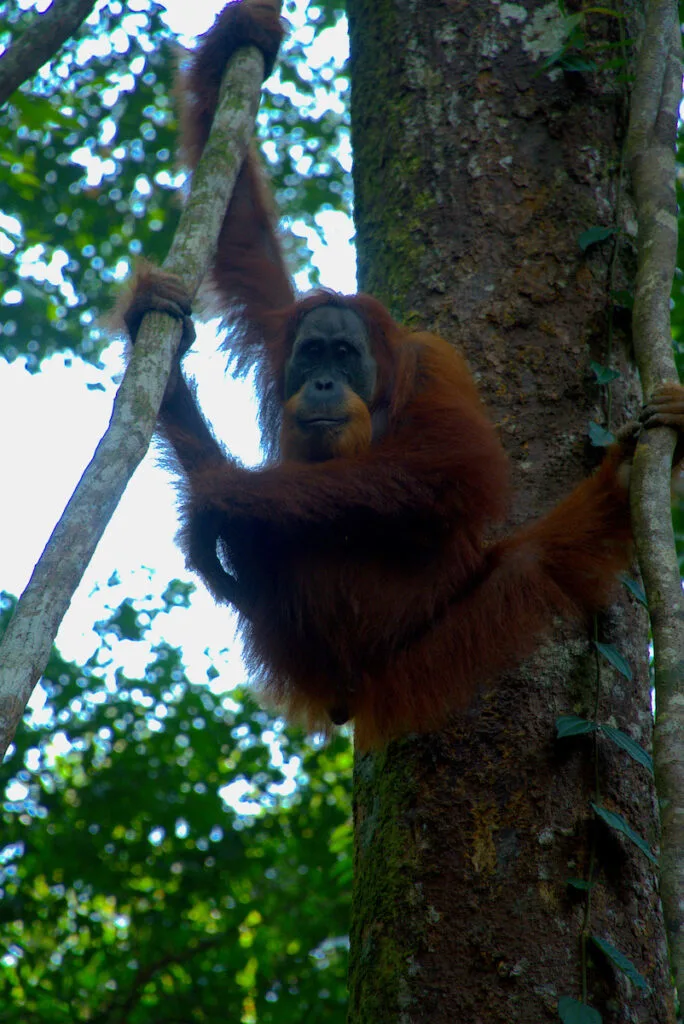
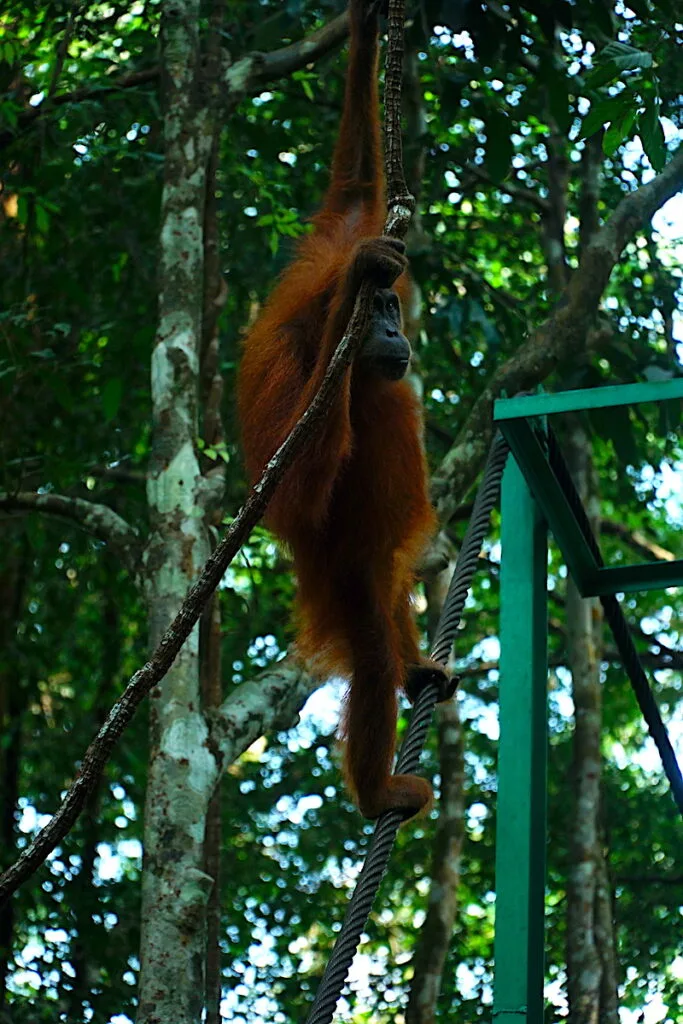
Trekking with orangutans in Bukit Lawang, Sumatra
After a short trek into the rainforest, I observed several different groups swinging through the trees and foraging.
A) Bukit Lawang (Gunung Leuser National Park)
✅ Best for: The most accessible orangutan treks in Indonesia; ethical viewings of semi-wild orangutans.
⏰ Best time to visit: April to May
There are two main places that people go for orangutan trekking in Sumatra: Bukit Lawang and Ketambe.
Out of the two, Bukit Lawang is the easiest to reach and has the most sophisticated selection of tours.
The nearest international airport is in Medan, only a two- to three-hour journey from Bukit Lawang.
Best visited between April and May, Bukit Lawang has a small orangutan rehabilitation sanctuary which supports semi-wild orangutans.
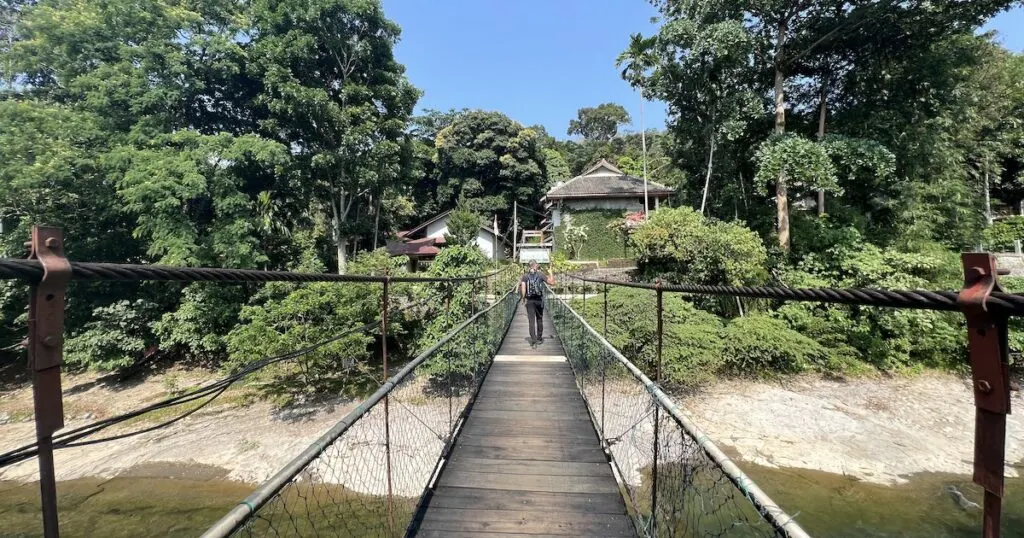
As I explain in my guide to the best things to do in Bukit Lawang, the sanctuary was established in 1973 by two Swiss zoologists.
They sought to protect and rehabilitate orangutans that had been captured or displaced by the logging and palm oil industry.
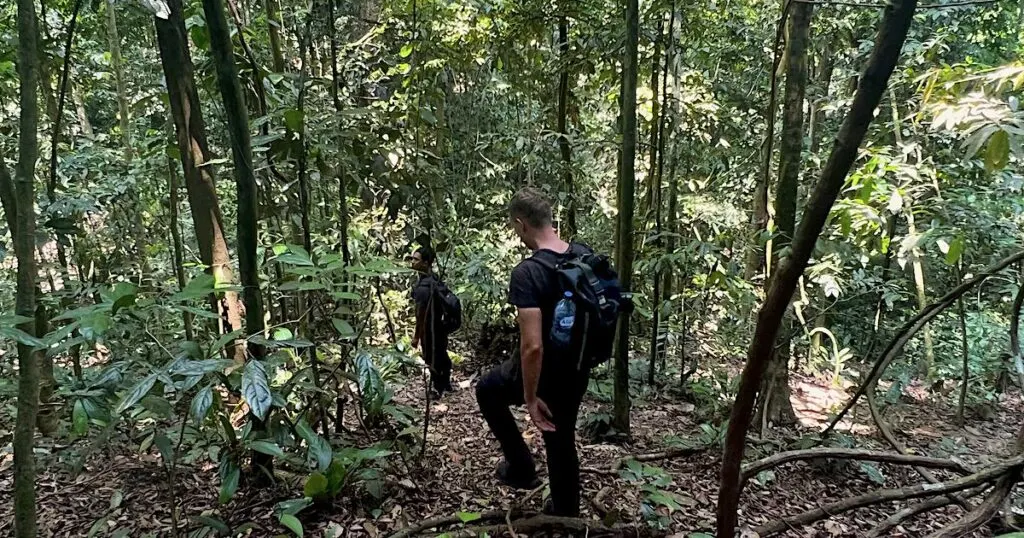
The semi-wild orangutans live freely in the Gunung Leuser National Park and forage for their own food.
Proceeds from orangutan treks are contributed towards the rehabilitation of the orangutans.
The orangutans that you will see in the area have either been directly rehabilitated or are the offspring of the original orangutans.

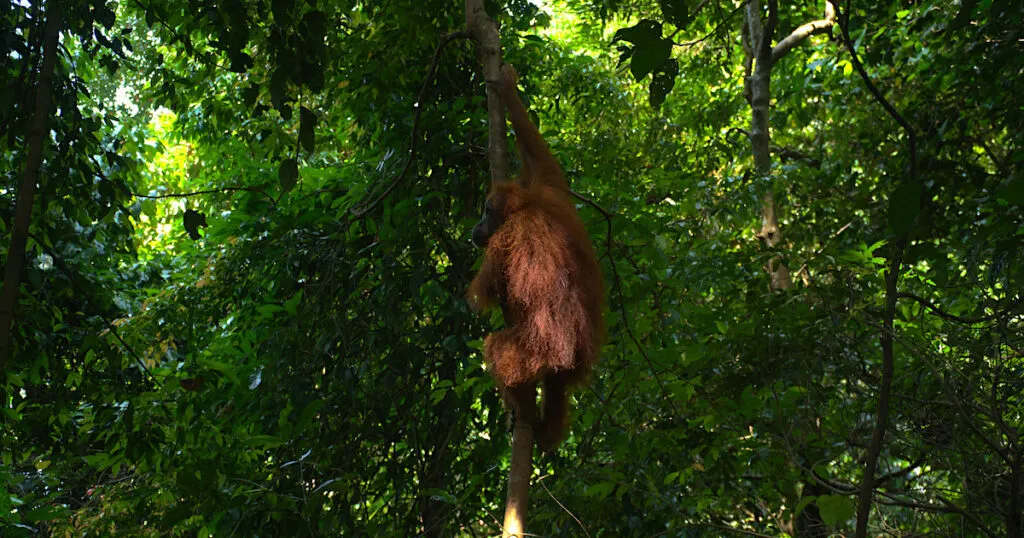
On my one-day trek, I came across a group of orangutans within 20 minutes of hiking – a very lucky experience, I was told – and saw several more groups throughout the day.
Our guide explained there’s a 50-50 chance of seeing orangutans. Therefore, taking a multi-day trek (with overnight camping in the rainforest) is highly recommended to boost your chances.
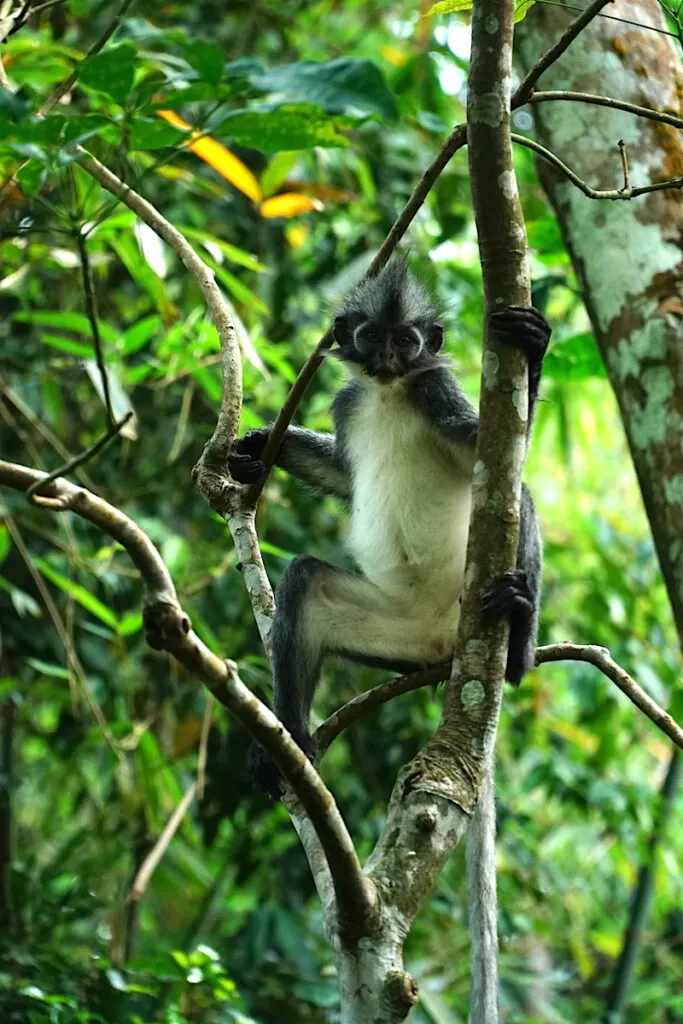
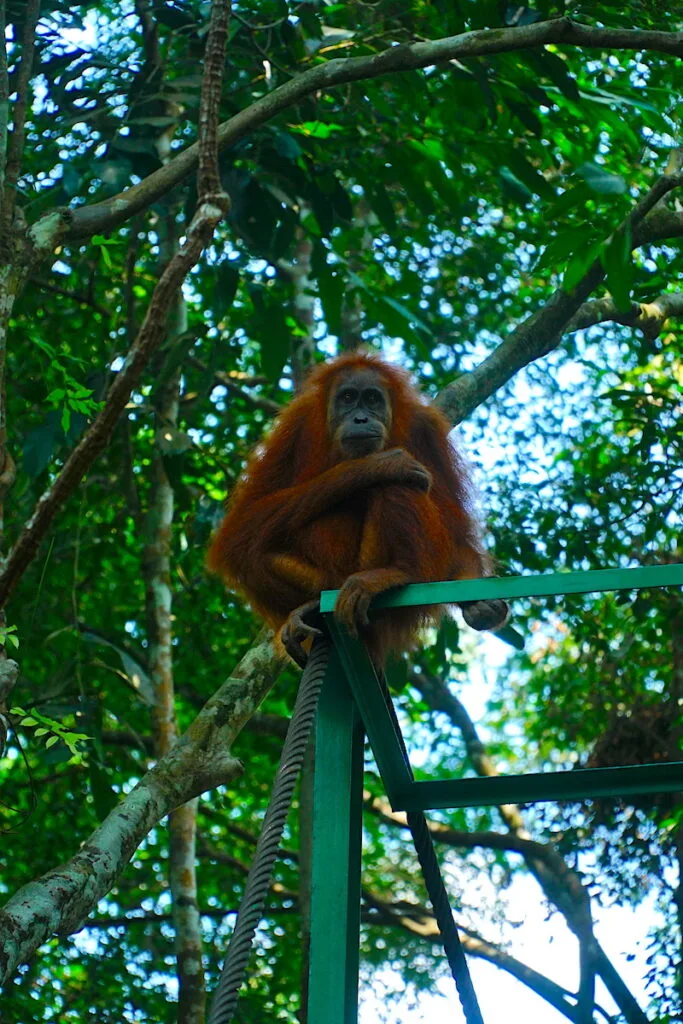
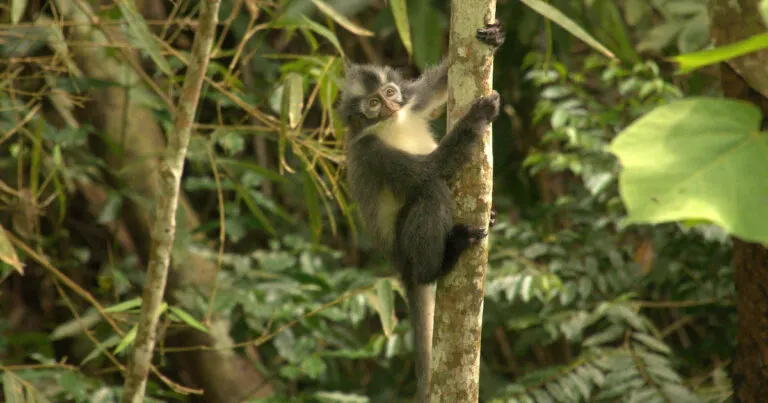
I also saw many Thomas’s langur monkeys, endemic to Sumatra, and a group of gibbons far away in a tree.
So, how exactly do you book an orangutan trek? Treks range from 1 to 3 days.
The tours by Ecolodge Bukit Lawang and Sumatra EcoTravel ( overnight jungle trek) have the best reputations. I used the former.
There is also the option of booking an overnight trek from Medan.
B) Ketambe (Gunung Leuser National Park)
✅ Best for: Less crowded and visits truly wild orangutans, but it’s harder to reach
⏰ Best time to visit: April to May
Ketambe is an alternative destination to see orangutans. The tours also take the form of orangutan treks (lasting multiple days) into the Gunung Leuser National Park.
However, the difference is if you’re lucky enough, you will see wild orangutans, not first- or second-generation rehabilitated orangutans.

What’s the catch? Ketambe is harder to get to – if you’re taking the bus from Medan, you need to take a bus to Kutacane (10 hours) and additional transport to Ketambe (one hour).
If you’re willing to go the distance, the payoff may be worth it. There are several guesthouses and tour companies that organise treks, so make sure to check their websites for ethical orangutan trekking practices.
2. Where to See Orangutans in Borneo
Borneo is the third-largest island in the world and a good place to see orangutans if you don’t want to hike or camp in the rainforest.
While I found it less than ideal for observing wild and semi-wild orangutans, there’s no getting past the fact that Malaysian Borneo is well setup for tourists, with luxurious hotels and experiences available.
The main places to see orangutans are the Kinabatangan River, accessible by boat, the Sepilok Orangutan Rehabilitation Centre – both in Sabah – and the Semenggoh Nature Reserve in Sarawak.
Even if you go off the beaten track to Tanjung Puting National Park in Kalimantan (the Indonesian part of Borneo), the tours are by boat. No hiking!

Kinabatangan River in Sabah
Approximately 57% of Borneo is covered in rainforest, making it a good place for wildlife-watching in general.
The island has clouded leopards, pygmy elephants, crocodiles and proboscis monkeys – although, I only saw the final two on my trip.

Proboscis monkeys
The proboscis monkey, a distinctive long-nosed monkey endemic to the island, is a big draw.
Wildlife watching aside, Borneo also offers good island hopping and a two-day hike up the 20th most prominent mountain in the world, Mount Kinabalu (4,095 metres).
A) Kinabatangan River, Sabah
✅ Best for: Seeing orangutans in the wild – however, if you get lucky, they’ll be at a distance.
⏰ Best time to visit: April to September
The Kinabatangan River is your best shot at seeing wild orangutans in Malaysian Borneo. Located on the west side of Sabah, the river has a population of over 1,000 wild orangutans.
As I explain in my guide to the Kinabatangan River cruise, whether you see an orangutan or not depends on luck. Some people may see several, whereas others see none.
Over two days, I didn’t see any orangutans, although I did see plenty of proboscis monkeys, a couple of crocodiles and lots of macaques.


Again, the longer your tour, the higher your chances of seeing orangutans. The dry season, from April to September, is an ideal time to visit because they are more likely to come to the river for water.

As far as tour experiences go, I liked my time on the Kinabatangan River.
There were only 5-10 boats on the river at a time, and they were well spaced out, so it didn’t feel crowded. The rainforest environment is also spectacular.
Another plus is that the accommodation along the river is comfortable; luxurious options are available for those who want it.

Naturally, high-season Kinabatangan River tours book up in advance, as it’s one of the best destinations to see wild orangutans in the world.
You can check availability in advance below:
- 3D2N tour: includes x5 river cruises and two nights at Tanjung Bulat Jungle Camp.
- 2D1N tour: includes x3 river cruises and one night at the same camp.
B) Sepilok Orangutan Rehabilitation Centre, Sabah
✅ Best for: Almost guaranteed sightings – however, it feels zoo-like.
⏰ Best time to visit: April to September
Located around 25 kilometres west of the Kinabatangan River, the Sepilok Orangutan Rehabilitation Centre is a good backup if you didn’t get to see wild orangutans at the river.
It’s also worth visiting instead of the Kinabatangan River if you don’t have enough time for a multi-day river tour.
Why are you more likely to see orangutans here? The rehabilitation centre runs two daily feeding sessions at 10am and 3pm.

The rehabilitation centre began in 1964 in an effort to rehabilitate orphaned young orangutans from palm oil plantations and logging sites.
Their ultimate goal is to release orangutans back into the rainforest by using mature orangutans to teach the younger and/or displaced orangutans how to carry out natural behaviours like foraging and building nests.
My main disappointment when I visited the orangutan sanctuary was that I felt like I was visiting a zoo.
Each feeding session begins at an indoor venue with tiered seating and large, glass panels.


I watched a handful of orangutans use the ropes and platforms to reach the food, then eat it. It wasn’t as interesting as my experience in the Sumatra rainforest.
This is immediately followed by another feed at an outdoor platform. However, I found myself in a crowd of 40+ people, who were making far too much noise.

At this platform, a dedicated worker spread out food for the monkeys and apes. They descended upon it from the surrounding treetops.
My Sepilok and Sandakan guide has more details on how to visit the orangutan sanctuary, the best times to go, and other things to do in the area.
C) Danum Valley Conservation Area, Sabah
✅ Best for: A wilder, more authentic experience with night drives – but it’s difficult to spot orangutans.
⏰ Best time to visit: April to September
The third most popular place to see orangutans in Sabah (north Borneo) is the Danum Valley Conservation Area.
There are only around 500 wild orangutans living in this area, so your chances of seeing one are fairly low.
However, the Danum Valley is known for being a particularly spectacular part of Borneo, with untouched rainforest containing orangutans, pygmy elephants, hornbills and clouded leopards.

Most people stay at the Danum Valley Rainforest Lodge, which runs birdwatching tours, night drives, river tubing, and walks on nature trails and a Canopy Walkway.
The rainforest lodge doubles up as a luxury hotel, so the popular 3D2N Rainforest Lodge tour doesn’t come cheap.
However, for many, it’s a bucket-list experience, mainly because of its nocturnal wildlife safaris in open-top vehicles.
D) Semenggoh Nature Reserve, Sarawak
✅ Best for: The best place to see orangutans in Sarawak; semi-wild orangutan sightings
⏰ Best time to visit: April to October
The best place to see orangutans in Sarawak is undoubtedly the Semenggoh Nature Reserve, which is a short 30-minute drive from Kuching.
You can easily fly into Kuching and get to the nature reserve for the next feeding session.
Similarly to the other orangutan rehabilitation centres, Semenggoh has been caring for injured, captured and orphaned orangutans since the late 1900s (1975, to be precise).

The orangutans are, therefore, semi-wild. They roam freely in the rainforest, but regularly emerge to attend the daily feeding sessions (at 9am and 3pm).
I haven’t had the chance to visit Semenggoh myself. However, it’s clear from the reviews that the centre is focused on the orangutans’ wellbeing.
They only provide food because the nature reserve doesn’t naturally provide all of the nutrients they need for a healthy diet. Sightings, as always, depend on the orangutans’ behaviours.

A taxi or Grab car takes only 30 minutes to reach the reserve from Kuching. Tickets cost RM10 for foreigners.
F) Matang Wildlife Centre (Kubah National Park), Sarawak
✅ Best for: Volunteering projects – however, questions have been raised about the ethics
Matang Wildlife Centre is a second orangutan rehabilitation centre near Kuching in Sarawak.
It was created after the Semenggoh Nature Reserve reached capacity. However, the orangutans kept at Matang are not yet ready for release, so they are kept in enclosures.
When they’re ready for release, the centre releases them into the surrounding Kubah National Park or destinations further afield
Looking at reviews of the centre, it seems that many of the animals are kept in small enclosures. Some reviews criticise the centre for not policing visitor behaviour and for not providing enough stimulation for the animals.
Therefore, I don’t plan to visit Matang Wildlife Centre in the future.
G) Tanjung Puting National Park, Indonesian Borneo (Kalimantan)
✅ Best for: A true adventure into Indonesian Borneo – living abroad a traditional klotok boat.
⏰ Best time to visit: June to October
Tanjung Puting National Park is high on my bucket list. Not many people go to Kalimantan (Indonesian Borneo) despite it being the region with the highest orangutan population on the island of Borneo.

It’s thought that there are over 57,000 orangutans in Kalimantan.
The best way to see them is to join a multi-day houseboat tour into the Tanjung Puting National Park from Pangkalan Bun (accessible with a direct flight from Jakarta – these are only available on 12Go).

The tours take place on a traditional klotok boat, which heads out onto the Sekonyer River for 3+ days.
It bears repeating: the longer your tour, the greater your chances at seeing orangutans. That’s because you’ll be able to go deeper into the rainforest.

The national park also has proboscis monkeys and gibbons. The river boats are simple but comfortable, most often including an air-conditioned ensuite room.
This 4-Day Tanjung Puting National Park tour departing from Pangkalan Bun has over 140 five-star reviews.
So, Which is Better for Orangutans: Sumatra or Borneo?
Let’s dive into a quick summary of the pros and cons of each place…
1. Trekking With Orangutans in Sumatra
Sumatra is the best destination to see orangutans overall. However, you must be prepared to trek and camp in the rainforest unless you try your luck on a one-day trek.
It’s less developed for tourism than Malaysian Borneo, but this helps to keep group sizes small.
Pros
✅ Not as crowded as Malaysian Borneo
✅ Orangutans roam in the forest
✅ Semi-wild or wild orangutans
✅ Spot Thomas’s langur and gibbons
✅ Nearby: Lake Toba (world’s largest crater lake)
Cons
❌ Requires trekking (1+ days)
❌ Less developed for tourism – fewer hotel and transport choices
❌ Better hotel and food options in Malaysian Borneo
❌ No chance to see proboscis monkeys
2. Visiting Orangutans in Malaysian Borneo
Malaysian Borneo is easy to visit and explore. However, you may get tired of the crowds or find the rehabilitation centres a little restrictive.
The best place to spot wild orangutans in Malaysian Borneo is on the Kinabatangan River. Sepilok Orangutan Rehabilitation Centre (Sabah) or the Semenggoh Nature Reserve (Sarawak) are good back-ups if you’re not lucky.
Pros
✅ Wild or semi-wild orangutans
✅ No hiking required
✅ Spot proboscis monkeys too
✅ Well-developed for tourism
✅ Easy to reach
✅ Nearby: Mount Kinabalu (spectacular mountain hike) and tropical islands
Cons
❌ Orangutan rehabilitation centres may feel zoo-like
❌ Binoculars may be needed
❌ More touristic – more crowds
❌ No chance to see Thomas’s langur; gibbon sightings are rare
Seeing Orangutans in Indonesian Borneo (Kalimantan)
If you’re ready to get properly off the beaten track, you can take a multi-day klotok (houseboat) tour in Tanjung Puting National Park (like this 4-Day Tour).
There are good chances of seeing orangutans, given that it has the densest orangutan population in Borneo.
Pros
✅ Spot wild orangutans
✅ The ultimate adventure by boat
✅ No hiking required
✅ Limited tour providers
✅ Not busy at all
Cons
❌ Requires 3+ days on a liveaboard
❌ Less developed for tourism
❌ Harder to reach
❌ Fewer tourist destinations nearby
I hope you found this guide to where to see orangutans useful.
Leave a comment below with your plans – I’d love to hear from you!
FAQ
Touching orangutans is an unethical animal practice, as it could pass diseases onto the animals. You cannot touch orangutans in any destinations in Borneo or elsewhere.
There are good odds of seeing orangutans in Borneo, especially if you visit the Sepilok orangutan sanctuary, where orangutans are fed several times daily. However, sightings are never guaranteed, especially at the Kinabatangan River, where the orangutans are fully wild and not fed by humans.
Seeing orangutans in Sumatra is not guaranteed. Taking a multi-day trek is recommended to maximise your chances of spotting the semi-wild or wild orangutans because they live and forage in the rainforest. Many people see multiple orangutans in the space of one day, whereas unlucky folks may not see one orangutan.